Here is one of the pictures featuring the Does Apple Use Google. Numerous images associated with the Does Apple Use Google can be utilized as your point of reference. Below, you'll find some additional pictures related to the Does Apple Use Google.
Apple, Google, Other Tech Giants Urge Texas to Drop Anti-Transgender Legislation
Apple, Google, Other Tech Giants Urge Texas to Drop Anti-Transgender Legislation
More than 60 companies, including tech giants Apple, Google, Microsoft, Meta and Salesforce, signed an open letter calling for Texas Gov. Greg Abbott and other lawmakers to abandon an order that equates gender-affirming medical care for transgender children to child abuse.
The letter, published in a full page ad in the Dallas Morning News on Friday, calls for an end to "efforts to write discrimination into law and policy." It was organized in partnership with LGBTQ+ civil rights group Human Rights Campaign.
"The recent attempt to criminalize a parent for helping their transgender child access medically necessary, age-appropriate healthcare in the state of Texas goes against the values of our companies," reads the open letter. "This policy creates fear for employees and their families, especially those with transgender children, who might now be faced with choosing to provide the best possible medical care for their children but risk having those children removed by child protective services for doing so."
See Also:In Texas, Big Tech's Liberal Leanings Take a Back Seat
In February, Abbott directed state agencies to investigate claims of children receiving gender-affirming medical care. The order also requires medical professionals and teachers to report children receiving care or face "criminal penalties."
The move drew swift backlash from civil rights groups and medical organizations. The American Medical Association supports "patient-led" gender-affirming care and has said attempts by states to prohibit care for minors patients are "inappropriate and harmful."
Apple CEO Tim Cook also spoke out about the issue in a tweet on Thursday. "As a proud member of the LGBTQ+ community, I am deeply concerned about laws being enacted across the country, particularly those focused on our vulnerable youth," Cook wrote. "I stand with them and the families, loved ones, and allies who support them."
Other companies that signed the letter include Box, Capital One, Cisco, Corning, Dropbox, Electronic Arts, Gearbox, IBM, Ikea, Johnson & Johnson, Patreon, PayPal, Pinterest, Shutterstock, SXSW, Unilever, VMWare, Yahoo and Yelp.
Best trade in deal for iphone best mobile phone trade in best phone trade in best cell phone trade in best buy cell phone trade in program best cell phone deals best cell phones 2021
Best Cell Phone Trade-In Options for iPhones and Android Phones
Best Cell Phone Trade-In Options for iPhones and Android Phones
With smartphone technology advancing at a lightning pace, it can be downright irresistible to snag the latest models, even if you already have a great device in your pocket. You might want more storage, a better camera, or you might just want the latest color. It may even be that your other personal needs have changed between the time you originally got your smartphone and now. Whatever your reasons for wanting to upgrade, you'll most likely want to get the best phone trade-in you can for your current model.
Furthermore, with the pandemic squeezing pocketbooks, there's a rising demand to get your money's worth out of a mobile trade-in. That's where the CNET directory of gadget trade-in providers comes in. We'll look at a few of the best phone trade-in options like ItsWorthMore and others where you can get top dollar for your devices.
Read more: Best Places to Sell Your Used Electronics in 2022
To evaluate the merchants on our list, we looked at a composite picture of each business. We ranked merchants based on our research into Better Business Bureau ratings, CNET staff reviews, online reputation among resellers and how easy or hard it is to get in touch with someone at each business, among other factors.
Every service is different, though, and trade-in values change by the day. They also assign values based on the condition of the cell phone you're trading in, and take into account things like the device's color. This means that preowned phones in good condition are likely worth more money or store credit.
So you're going to have to shop around. Below the list of merchants is our basic FAQ of carriers, buyers and online marketplaces for your best phone trade-in experience.
Smartphones: Yes
Tablets: Yes
Laptops: Yes
iPods: Yes
Action cameras: Yes
Wearables: Yes
Other: Kindles, books, video, more
Not surprisingly for the king of online commerce, Amazon offers trade-in pricing for a large number of items, including phones and tablets, as well as books and videos. Because Amazon also has its own marketplace, you can also choose to list pretty much anything and expect to have a chance to sell it through Amazon.
We focused specifically on the Amazon Trade-in offering only. If you're not a regular Amazon customer, you might be disappointed to find that Amazon only pays in Amazon Gift Cards. For those of us who are dedicated Prime users, that's pretty much the same as cash, but you need to decide.
There's long been a rumor that Prime customers get better trade-in prices than non-Prime customers, but when we asked Amazon, we were told that everyone was treated equally.
In terms of the mechanics of the trade-in, Amazon will send you a prepaid shipping label you can print out. Pack the device yourself in your own packaging (like an old Amazon box) and send it back. You should clear your phone of data, but Amazon will also do that for you. Make sure you don't dawdle when shipping your item. The quote time is valid only for seven days, and you should get paid in about 10 business days.
Angela Lang/CNET
Smartphones: Yes
Tablets: Yes
Apple offers two ways to trade in your iPhones and iPads. You can either walk into an Apple Store or use an online service run by Apple partner Phobio.
Either way, don't expect to trade in your iPhone and get money you can use to go out and buy that hot new Google Pixel 4 phone. Apple's trade-in services only give you Apple Gift Cards. If you're staying in the Apple ecosystem, this might work for you. If you're jumping ship or just need the money, you'll need to look to another alternative.
I liked the convenience of a walk-in trade-in, assuming you're near an Apple Store. If you go the online route, quote time is valid only for 14 days, and you should get paid quite quickly, with the company promising two business days in most cases.
Like Amazon, going with Apple is a bit of a no-brainer, but only if you're OK with its limits: iPads and iPhones only, exchanged for Apple Gift Cards only.
Gadget Gone
Smartphones: iPhones only
Other: Contact merchant directly
If you want to sell your iPhone (and only your iPhone) to a company with a fun tag line, GadgetGone is for you. The site has "Goodbye iPhone. Hello Moola" plastered on the front page, just in case you didn't understand what it does. It claims to take items other than iPhones, but its online estimator only works for iPhones. You have to email to find out what else it's interested in.
The company pays by check and PayPal, but also will pay you using a "printable echeck." While printable checks are a pretty standard practice for some businesses, you probably should ask your bank whether they'll accept a check printed out on your inkjet.
I like the company's "two days to payment" policy, but GadgetGone stumbles on its lack of security practices and price offer guarantees. It also provides no clear method for phone support, and offers almost no background on the company itself on its website.
igotoffer
Smartphones: Yes
Tablets: Yes
Laptops: Yes
Wearables: Yes
Other: Macs
If you dig deep in its menu system, you will find Samsung and Google phones listed for trade-in at igotoffer, but this is mostly an Apple-branded trade-in shop. Not only does it make offers on Apple phones, but also on Mac Pros, Apple Displays and Apple TVs.
That said, igotoffer doesn't let you know how long its offer quote is good for, and it doesn't specify whether it provides a security wipe on your data (you should do it anyway). There also appears to be no telephone support.
If you do want to trade in your iPhone, the company will email you a prepaid shipping label you can print out. That's workable, but I prefer the full shipping kit with a box designed to protect your device. igotoffer says it pays within three business days by check, PayPal or Amazon Gift Card.
It'sworthmore
Smartphones: Yes
Tablets: Yes
Laptops: Yes
iPods: Yes
Wearables: Yes
Desktops: Yes
Most of what It'sWorthMore accepts are Apple products, but the company also lists Android devices and some other laptops and tablets.
The company provides a 14-day offer quote guarantee and a prepaid shipping label, and it pledges to pay within three business days. It also provides phone support.
It'sWorthMore pays by check and PayPal, but here's a kicker. If you ask for payment via PayPal, the company deducts 3% to cover its PayPal fees. It's a little too nickel-and-dime for our tastes and makes us wonder whether it'll be generous in its final payment determinations, or if it will be just a little too cheap. If you use this service, let us know how it did from quote to final payment in the comments below.
Decluttr
Smartphones: Yes
Tablets: Yes
Laptops: Yes
Wearables: Yes
Other: Media, Lego, Games
If you want to get money for your clutter, Deculttr Is the place to bring your stuff. They take in many different smartphone models, some tablets, some Kindle models, game consoles and games, DVDs, CDs, Blu-rays and Lego products (Hey, don't knock the Lego. That stuff has a pretty high resale value, especially with full sets).
Although they don't provide a shipping kit, we liked how they suggested filling a box (they say any box will do) with up to 200 items and send it into decluttr.com. It's a great way to clear out a pile of gear and get some money back.
Plus, you can trade-in your device an earn an extra 10% of trade-in value (maximum $40) code CNET10EXTRA.
We don't like that the company doesn't clearly specify how long their price quotes are good for, and that it doesn't explicitly state that it wipes your technology on receipt. Instead, they have some FAQ entries about how you can do that yourself.
That said, the company does offer solid phone support and a great way to check the value of products before shipping, and free insurance on items you ship to them.
What about Gazelle?
Gazelle has lived on this list for a long time, but after refining our review criteria, we've removed it. The change comes in light of an increased number of poor customer reviews and recent complaints to the BBB. We will continue to update this list over time.
FAQ: Carriers, buyers and online marketplaces
When looking for value from your old phone, there are four types of organizations you can work with: retailers, buyers, marketplaces and carriers. The characteristics of each are quite different:
Retailers: These are the brick-and-mortar stores in your neighborhood, ranging from Walmart and Target all the way to the remaining Radio Shack locations. In many cases, you can walk into the retailer, hand over your old Apple, Google or android phone and walk out with a new one, with a healthy discount applied. Many of these retailers won't just give you money for your old phone. They want the deal for your new business and give you a trade-in offer, so keep that in mind. Some also offer online trade-ins.
Carriers: These are the cellular service providers and almost all of them have some sort of mobile phone trade-in program, to encourage you to trade up to the next model and keep their service. Good news: this doesn't necessarily mean that the phone needs to be in working condition.
Buyers: These folks want your phones and will give you money or credit for them. A buyer generally won't force you to buy a new device from them (although expect some deal sweeteners if you go that way). Some of them will send you packaging to send your device back to them. This is the group we look at in this guide because they generally send you real money in return for your device, which means you're free to buy anything you want once you get your green.
Marketplaces: This option includes the classic resell methods like Craigslist and eBay, along with some specialty referral marketplaces like Flipsy, which are built around the idea of trading in gadgets. Here, you're often dealing directly with individual buyers (or bulk buyers who are scooping up phones for other markets). Straight talk, though: There is substantially more risk when selling to individuals than companies with known reputations.
Keep those concepts in mind as you look for the best deal for your device.
Xiaomi Mi 6 review: The best phone you can't buy (for now)
Xiaomi Mi 6 review: The best phone you can't buy (for now)
I love the Mi 6 for what it is -- an amazing device with the same speedy processor as the Samsung Galaxy S8 and a beautiful design that stands out on its own. It also comes with dual-cameras, and takes portrait pictures like the Apple iPhone 7 Plus and now, the OnePlus 5. You get Android goodness with some Apple-like features. And it costs a lot less than your typical flagship phone. What's not to like?
Well, how about the fact that it's still only available in China two months on from its launch. Xiaomi said it would reach other countries "soon", but it couldn't tell me when exactly it's going to start rolling out.
While eager beavers could order a Mi 6 from China, take heed that the LTE may not work in countries such as the US -- you'll have to compare to your carrier's network bands to be sure. And there are no Google Play services in China so until the company releases a global ROM, you'd have to sideload it if you want native apps such as Google Maps.
The lack of global availability means Xiaomi may be missing the boat in most markets that would have loved to grab a Qualcomm Snapdragon 835 powered phone on the cheap. The cheapest version of the phone retails for about $365, £280 or AU$485 converted, and that model gets you 4GB RAM and 64GB of onboard storage. Step it up to the 6GB RAM version with 128GB onboard storage and you'll pay 2,899 Chinese yuan -- about $420, £330 or AU$560.
A premium ceramic version with 18K gold finish and 128GB of storage space sells for just a little more at 2,999 Chinese yuan. That's about $435, £340 or AU$580.
If you're lucky enough to get and use the Mi 6, you'll find an affordable flagship that matches the Galaxy S8 where it counts. Though it's missing some features, including wireless charging. It makes you wonder just how much of a premium you're paying for other high-end flagships such as the Galaxy S8 or the Sony Xperia XZ Premium. If you live outside China, keep reading to see what the Mi 6 will bring you -- but hold out for the international version before committing.
The power and volume buttons are located on the same side -- and the only problem with that is that I can't use it with my car mount -- the clamps press down on the power button, turning it off.
Aloysius Low/CNET
All the bling in the world
The Mi 6's glass and stainless steel frame stand out. The phone comes in the standard shades of black or white, plus a much snazzier blue-and-gold version that's visually stunning.
I particularly loved that color, and it's a great conversation starter as well. I can't tell you how many people looked at it and said, "Wow." That said, the glass rear can be a tad slippery to hold at times.
The Mi 6 has a 5.15-inch screen with a 1080-pixel display that looks good to the naked eye. Pixel density isn't as sharp on paper as the Galaxy S8, but my eyes didn't strain trying to read news stories or social media updates. Colors pop, and while it has a maximum brightness of 600 nits, it goes all the way down to one at night, helping you not strain your eye. The phone won't take a long dunking like the Galaxy S8 or LG G6, but it is splash-proof, so you shouldn't worry too much about small spills.
Like other Xiaomi phones, the Mi 6 runs MIUI, a customized version of Android 7.1.1.
Double the cameras
One of the Mi 6's key features is its dual 12-megapixel camera setup, which is a hot trend these days. While it's not the first time Xiaomi has used it on phones, it's the first time a Xiaomi phone has added portrait mode similar to the one found in the iPhone 7 Plus (Xiaomi even calls it the same thing).
Portrait Mode works the same way as it does on the iPhone 7 Plus: you stand in front of the object and let the phone apply the effect. It's much simpler than the effect on previous Xioami models such as the Redmi Pro, which let you tweak the depth of field after shooting the picture. As for the quality, well, that's trickier. The Mi 6's Portrait Mode feels very finicky; half the time it detects the object properly, the other time you're either too close to apply the effect or the picture winds up being too out of focus.
The dual-cameras of the Mi 6 can take Portrait Mode pictures just like the iPhone.
Aloysius Low/CNET
But when it does work, the subject remains in focus while blurring everything else. Results are pretty compelling. Check out the picture below for an example.
Portrait mode gets you good looking shots.
Aloysius Low/CNET
Aside from Portrait Mode, the Mi 6 takes great pictures, especially in bright light. It isn't as capable as the Pixel XL or the Samsung Galaxy S8 in low light, but then again, which phone is? The quality of its low-light shots is similar to the iPhone but more saturated, giving images a nice pop, even if they're not 100 percent realistic.
Besides Portrait mode, the Mi 6 also does 2x lossless zoom -- again like the iPhone. Xiaomi's features here are good, but the Mi 6 does lean on the iPhone for a lot of its inspiration, a critique I had of its past phones, too.
HDR shots really pop, though the sky is slightly washed out.
Aloysius Low/CNET
Interestingly, the Mi 6's HDR function now has its own dedicated button you'll have to manually switch on and off. It doesn't seem to turn on HDR automatically the way many other phones do.
Selfies came out looking good, but the 8-megapixel Mi 6's front-facing camera ran into the same problems as a lot of other phones when it comes to bad lighting. You just can't get around terrible backlighting. It also comes with a beauty mode, which made my face look baby smooth (it's really not).
The selfie camera doesn't do well with backlit backgrounds (like most phones).
Aloysius Low/CNET
Where's the jack?
The Mi 6 joins the list of phones with no dedicated headphone jack. Instead, you'll have to use the USB-C charging port for wired headphones, or use a set of wireless Bluetooth headphones. However, the phone does come with a USB Type-C to 3.5mm audio jack converter in the box. Honestly, I'm not as bothered by the lack of an audio jack, since I prefer using wireless headphones to cut down on loose cables anyhow. You may feel differently, of course.
The phone uses Type-C USB and has no audio jack.
Aloysius Low/CNET
Smooth performance and long battery life
Qualcomm's Snapdragon 836 processor keeps the Mi 6 buttery smooth. You won't notice any lag when switching between apps or playing 3D games such as Dynasty Warriors: Unleashed. You'll love how snappy everything is. Battery life is superb as well. It lasted 17 hours 35 minutes in our lab tests and chugged through a full day of relatively heavy use without dying on me. For reference, the Galaxy S8 lasted an average of 16 hours in our video drain tests, and the S8 Plus went 18 hours.
Take Better Vacation Photos: 7 Tips From a Travel Buff
Take Better Vacation Photos: 7 Tips From a Travel Buff
Here's a secret: You don't need an expensive camera to get great photos. Sure, it can help, and there are some photos only a "real" camera can take. However, you might be surprised at how good your photos can be just using your phone or an inexpensive camera. Learning these tips and techniques will help you if you ever upgrade to a big camera too.
Who am I to give this advice? I'm a travel writer and photographer, with over 150 photo galleries here on CNET taken all over the world. I have an expensive camera, sure, but I also use my phone more than you'd expect.
There's an overused, but still true, adage: The best camera is the one you have with you. So if you can get photos you like without spending money on a camera you might only use once or twice a year, even better.
While each phone is slightly different in its hardware and camera app, I've kept the following tips general enough that they should work on just about every device. More expensive phones can generally take higher quality images than cheaper phones, but you should be able to get great results no matter what you have. Also, if you're confused by any of the terminology, there's a glossary of some often-used camera terms at the bottom.
For more, here's how to take great vacation videos with your phone camera and some tips for getting great shotseven if your phone is old. Plus, here are the seven things you should always pack when you travel and what travel veterans recommend before leaving on vacation.
1. Clean the lens
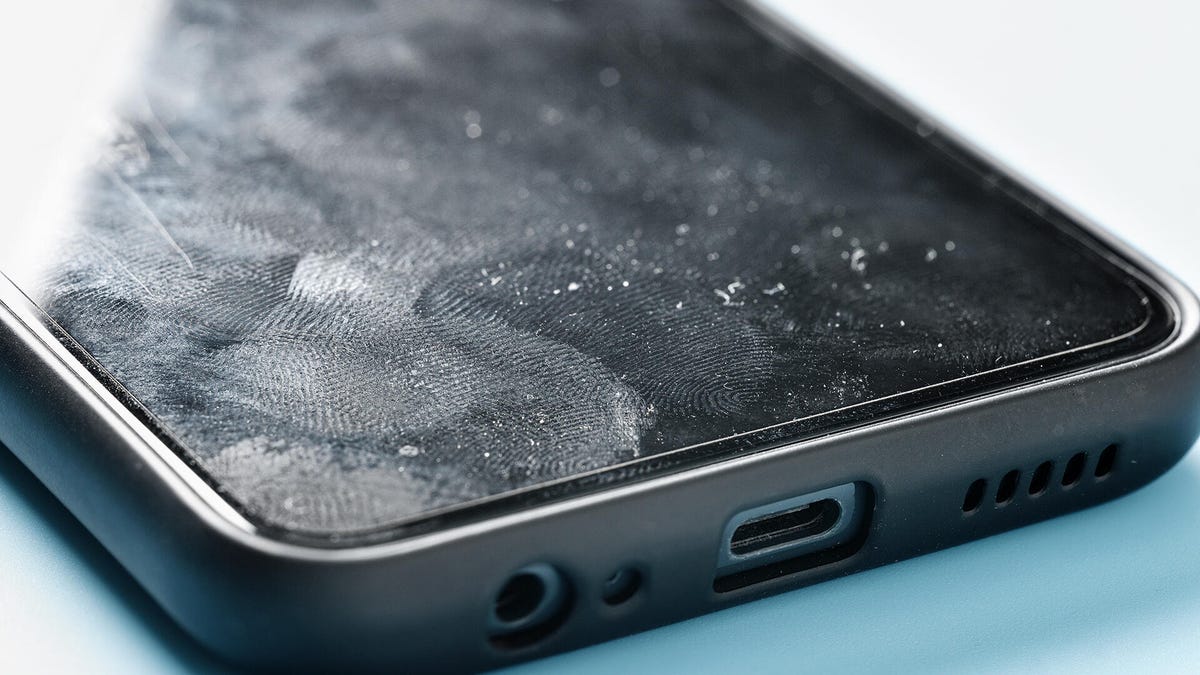
Does your phone screen look like this? I bet the camera does too. Few things can improve the quality of your photos more than a clean camera lens.
Serhii Shleihel/GettyImages
I can't stress enough how important this is. Well, I guess I can stress it since I'm putting it first. I'm amazed how often I see washed out and smudged images that are the result of fingerprints or other schmutz on the camera lens. Just cleaning your lens will improve the quality of your images probably more than any other tip.
How often? I literally check my camera lens before every group of photos. Important ones, anyway. Phone comes out of my pocket, I check the camera lens.
Ideally, you'll use a microfiber cloth, the same sort that comes with glasses/sunglasses. If not, even a soft shirt will be fine. Nothing rough or coarse. Nikon sells a nice microfiber cloth that comes in its own tiny neoprene baggie. This keeps it clean and conveniently on hand.
If you have a real camera, always (always always always) use a lens cap. I get such anxiety when I see people pull a camera from a bag, or have it dangling around their neck, and there's no lens cap. Scratches are even worse than smudges since they permanently decrease the image quality possible with the lens. Lenses are the eyeballs of your camera. Treat them as such.
If you're worried about losing your lens cap, or hate juggling it while you're handling your camera, check out cheap lens cap straps. They're great.
2. Tap the screen
The camera app on a Google Pixel
Google
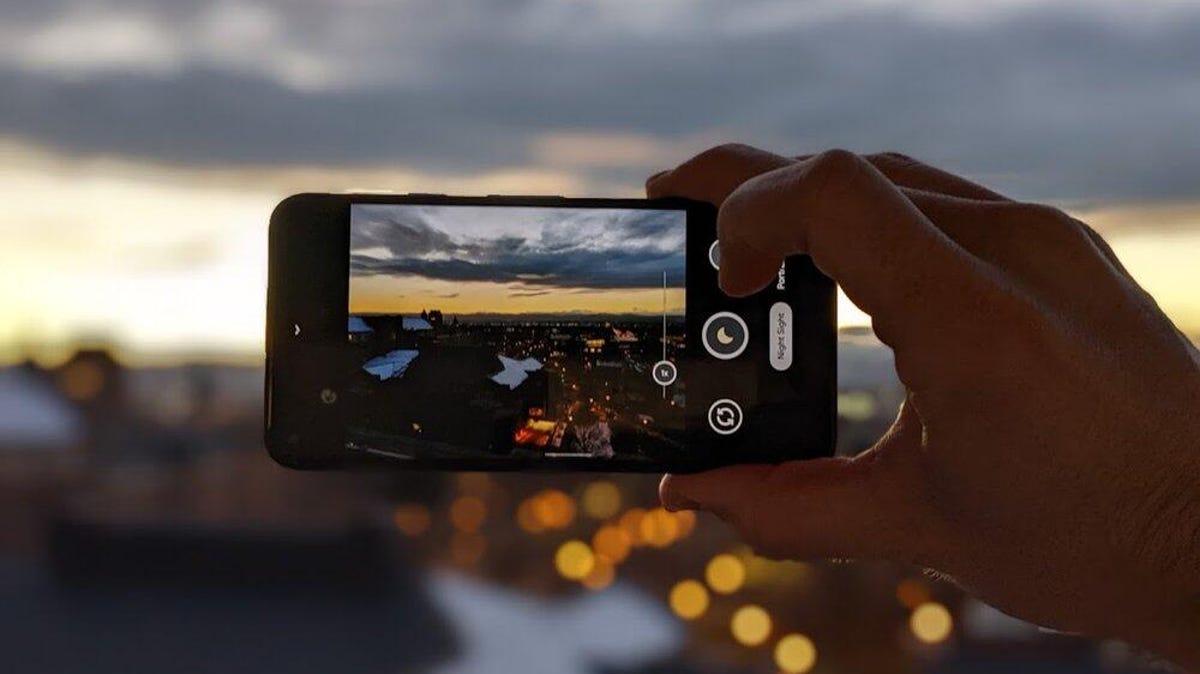
This always seemed obvious to me, but I've regularly caused "ah-ha!" moments giving this advice. When lining up your shot, if it doesn't look right, tap the screen. Most phones are pretty good at figuring out what you're trying to photograph, but not always. Tapping on your subject, a person, animal, thing, whatever, and changes the focus and exposure.
Here's an example. Say you want to take a photo of your partner on the beach at sunset. Three beautiful things in one photo: partner, setting sun, ocean. The beach too I suppose unless you don't like sand. This is called a backlit photo, and it's extremely hard to do. Most often, your partner will be underexposed (see the terminology section below), as in they'll look dark/shadowed.
With most phone and camera apps, you can tell the camera where to expose the image. In this case, on your partner. The sun will then be overexposed (blown out), but you'll still get the idea it's a sunset and you'll be able to see your partner, which is generally the point, right? If your phone is able to take HDR photos, this image will look better than if it can't.
There is some editing you can do to make a photo like this look better, but that can only go so far. We'll get to editing a little later.
3. Don't use the flash
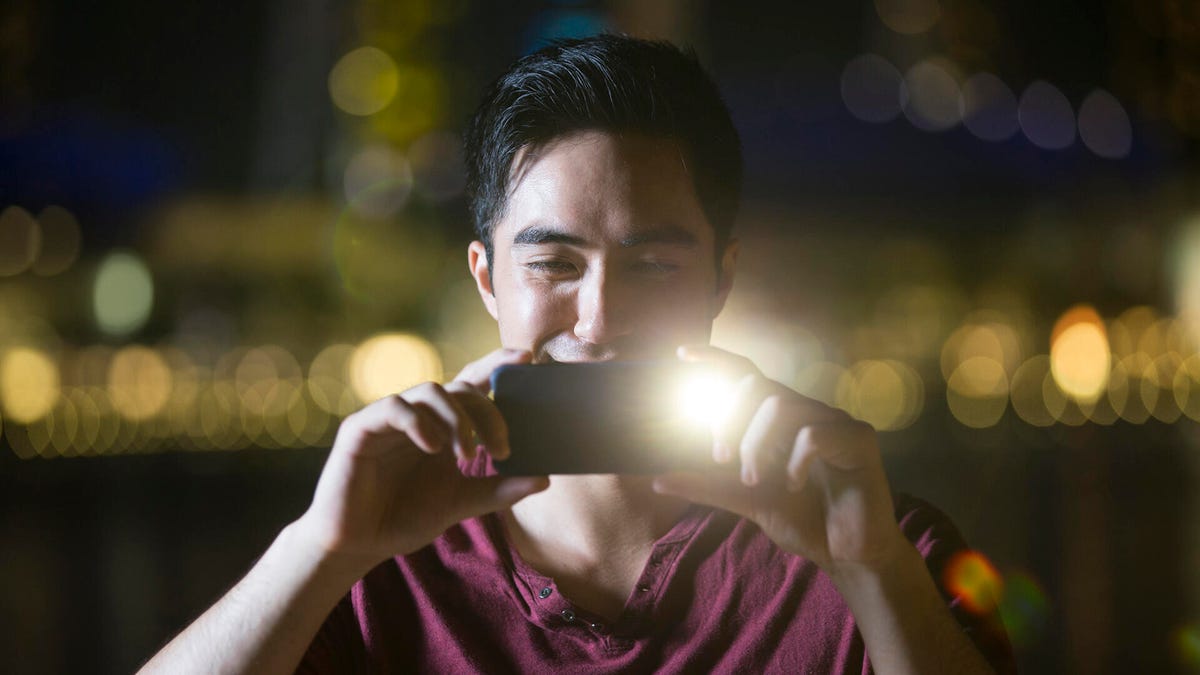
If you're this close to your subject, sure, try the flash. Most phones and cameras have decent low-light capabilities, so the image might look better with the flash turned off. It's worth checking.
Jenner Images/Getty Images
There's no such thing as a good camera flash on a phone. They're all terrible. Even the big add-on flashes for full-size cameras only work in certain situations. Believe it or not, in most cases you'll get a better photo turning the flash off completely. Not 100% of the time, however, so it's worth trying both options.
This is especially true if you're using a full-size camera with built-in flash. In every scenic place I've ever been there's at least one person trying to take a landscape photo and their flash fires. Flashes, even the best, only work within a few feet of the subject. Not only will they do nothing for landscapes, they'll wear down your battery faster at best, and mess with the exposure at worst.
You can turn off the flash in your camera app's settings. More on that below.
There is such a thing as a Slow Sync Flash photography that can be great when trying to photograph people in front of a twilight or night landscape. I'd classify this as a bit more advanced, but with a bit of practice the results can be great!
4. Get a selfie stick
Grandma's gonna find that reindeer and enact revenge.
Geber86/Getty Images
Selfie sticks are good. I have apishly long arms and I still have one, though I typically use it for my 360 camera. My 80-year-old dad has one. They're great. People should take more photos of themselves, of their family and friends, everything. I honestly don't get the hate. Photos are great! Preserve whatever memories you can. Future you will thank you.
To put it more pragmatically, a selfie stick will let you get a wider field of view of yourself, the people you're with and where you are. It just makes for a better photo.
When you're using them, certainly be wary of your immediate surroundings and the people near you. Some locations, especially crowded or dangerous ones, tend to restrict selfie stick usage. Keep an eye out for signage.
If you're not sure how much you'll use it, there's this $8 option on Amazon that extends to 28.7 inches, has a Bluetooth remote built in, and has a base that extends out into a tripod. It collapses down quite small too. For something a bit more elaborate and sturdy for an action camera, GoPro's own 3-way 2.0 configures to a wide variety of positions and angles. It's made for their cameras, of course, but many action cameras use the GoPro-style mount.
5. Get a better angle
This is Smeagol and he is a Very Good Boy.
Geoffrey Morrison/CNET
Most people just bring the phone or camera up to eye level and take the photo. Sometimes that's fine, but you can often get far better results with a different angle. Try holding the camera above your head and aim down. Photographing people from below tends to be rather unflattering, but slightly above often looks great. If you're taking a picture of a kid or animal, get down to their level. A dog's-eye-view of a dog is almost always a more interesting photo than a human's-eye-view of a dog.
This is an aspect where a selfie stick helps. Extend it out and you'll be able to easily frame that epic photo of you and the fam at the Grand Canyon where you can see you, the fam, and the Grand Canyon instead of you, parts of the fam, and a sliver of the Grand Canyon.
6. Learn your app's settings and modes
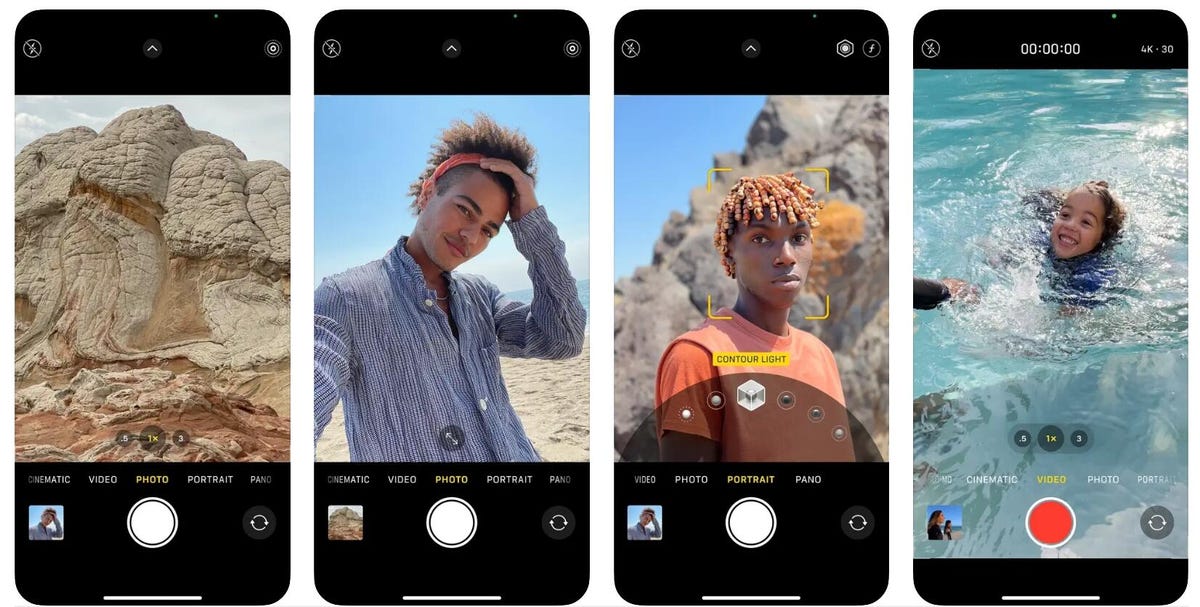
Changing the default settings on your phone's camera app can have big results.
Apple
Nearly every phone's camera app is capable of a variety of different photo styles. I'm always surprised to see how many people have no idea. Portrait mode, landscape mode and night mode all let you take vastly more interesting photos than the basic mode, all with just a few taps on the screen. Check them out, see what they do.
As far as settings go, generally the stock ones should be fine. It's worth checking to make sure it's taking the highest-resolution it can and that the flash is turned off (see No. 3). Some apps let you shoot RAW, more info on that in the terms section below.
I'd also recommend enabling manual controls, if available. They'll just take a few minutes to learn and they should help you get the photo you want when, like described in No. 2, the camera itself is struggling to do so.
Fun fact: Many camera apps have the option to use one of the phone's buttons as the shutter. If it's too hard for you to tap the screen while holding the phone, perhaps using the volume button instead will be easier. There are also timer functions that give you a countdown of a few seconds to get your pose and people ready.
Read more: How to Use the iPhone's ProRaw Mode to Make Your Photos Look Better Than Before
7. Editing
Note the different editing possibilities cycling through on the right.
Google
Nearly every great digital photo you've ever seen has gone through some amount of editing. Colloquially this is called "Photoshopping" but you don't need to pay Adobe for a subscription to that specific program. In fact, there are a lot of free options. Your phone might have some built in to its gallery already. Instagram has some great adjustments too. Beyond those, check out CNET's best free and paid photo editing apps for iPhone and Android.
The easiest way to learn is to just pick a photo and see what all the options do. Visually, it will be pretty obvious what things like contrast, brightness, and so on actually do. Most of them do the same thing on your TV, if you're interested.
Slight tweaks to contrast, brightness, and color will do wonders for any image. You can "slap a filter on it," sure, but starting with a better base image will usually make it look better after you apply a filter too.
Bonus! Cloud backup
Ymgerman
While not a camera tip per se, I very strongly recommend getting some sort of cloud backup for your photos. Integrated with your phone this means that whenever you're on Wi-Fi all your photos will get backed up to the cloud. With a real camera you can download them to the camera's phone app, and usually they'll get sent to the cloud from there. Sometimes, like with GoPro, there's an extra step required to save them to your phone's gallery.
With a cloud backup if you lose your phone or camera, you won't lose your photos. This saved me in a big way when I got robbed on an overnight train in Italy, and another time when a hard drive crashed on me.
Also, never forget, there are only two types of hard drives: Those that have failed, and those that will fail.
Check out our six ways to keep your photos safe in case of an emergency and best cloud storage services for 2022.
When to upgrade
As you get to know your phone's camera, you'll start to find its limitations. A limited zoom is going to be the most obvious, followed by noise in the image, a lack of settings, and so on. Some of you will start wanting more. It's a logical progression, one I bounded through myself, from inexpensive options to more and more expensive options. It's a pricey hobby, to be sure. Buying used can help.
I recommend checking out my Best Camera for Summer Travel article as a next step. It's aimed towards vacation/travel options, but should give you an idea what's out there and what the upgrade steps look like.
Terms and words and stuff
You'll find these terms when reading about actual cameras, as well as about phone cameras and within apps.
Wide angle: A type of lens that typically captures more than what you'd see with your eyes in one glance. The whole forest instead of a single tree, so to speak.
A wide angle photo, taken with my phone, of the Root Glacier in Wrangell-St. Elias National Park. Note the tiny people in the lower left.
Geoffrey Morrison/CNET
Telephoto: The tree, not the forest. Telephoto lenses let you capture images where you seem right up close to a subject but were actually far away.
Standing in the same place as the above photo, but with a 135mm telephoto lens on a Canon R6. These are the same hikers, a few minutes earlier, as they made their way across the glacier. Note how much closer they seem.
Geoffrey Morrison/CNET
SLR/DSLR: Single Lens Reflex/Digital Single Lens Reflex. Historically the "big, real camera." Usually a shorthand for a camera where you can change the lenses. Gradually being replaced, even among expensive cameras, with mirrorless versions.
Mirrorless: Lacking the moving mirror found in all SLR/DSLR cameras. What this means for you is the cameras are slightly smaller and lighter. Offered in a wide variety of prices. At the top end they're replacing professional DSLRs.
35mm equivalent: Refers to 35 millimeter film, the old standard, as a way to describe how wide, or telephoto, a lens is. For example, a 35mm-equivalent 12mm lens is wide, a 100mm lens is telephoto. Used as a relative reference since the actual focal length will vary depending on the size of the image sensor.
Optical zoom: This is the only real zoom. Uses glass or plastic lenses to make a subject appear closer.
Digital zoom: Best to think of this as "fake" zoom. It merely crops the image, and then upconverts it. Doesn't make the subject more detailed, just larger. OK if there's no other option, but the image quality is vastly inferior to optical zoom.
Underexposed: A subject or image that's darker than desired.
Overexposed: A subject or image that's brighter than desired.
RAW: An image format that's just very lightly processed data from the image sensor. At the professional level, RAW files are used almost exclusively as there is more range available to edit. However, you need to be knowledgeable with photo editing and have an app/software that can edit your camera/phone's RAW files. Not for beginners.
As well as covering TV and other display tech, Geoff does photo tours of cool museums and locations around the world, including nuclear submarines, massive aircraft carriers, medieval castles, epic 10,000-mile road trips, and more. Check out Tech Treks for all his tours and adventures.
He wrote a bestselling sci-fi novel about city-size submarines, along with a sequel. You can follow his adventures on Instagram and his YouTube channel.
Galaxy s21 ultra 5g review samsung s premier phone is pretty a noun galaxy s21 ultra 5g review samsung s premier phone is pretty an adjective galaxy s21 ultra 5g review samsung s premier phone is pretty an adverb galaxy s21 ultra 5g review samsung s premier phone holder galaxy s21 ultra 5g review samsung s20 galaxy s21 ultra 5g review samsung s 10 galaxy s21 ultra 5g review samsung sound galaxy s21 ultra 5g review samsung phones galaxy s21 ultra 5g 128gb unlocked galaxy s21 ultra 5g 512gb iphone 13 pro max vs galaxy s21 ultra galaxy s21 ultra review
Galaxy S21 Ultra 5G review: Samsung's premier phone is pretty badass
Galaxy S21 Ultra 5G review: Samsung's premier phone is pretty badass
The Galaxy S21 Ultra 5G, unveiled alongside Samsung's Galaxy S21 and S21 Plus phones, proves that sometimes you have to do something twice to get it right. While just as bold as last year's Galaxy S20 Ultra, the S21 Ultra is a refined second take on the concept. There's still the 100x Space Zoom, but it's easier to use. There is still the "big for the sake of being big" design, but it looks more appealing. And there's still a high price, but at $1,200 (£1,149, AU$1,849) it costs $200 less than the S20 Ultra in the US.
If you want the absolute best specs and features, the S21 Ultra is undoubtedly appealing. The phone will also attract camera nerds, thanks to the improvements. The addition of S-Pen support -- it's the first Galaxy S phone to support the stylus -- will likely catch the eye of Galaxy Note users looking for a different option.
Like
Gorgeous phantom black finish
Two telephoto cameras
The screen is spectacular
S-Pen support
Don't Like
It's heavy
Lacks a microSD card slot
$1,200 is still expensive
Last year's Ultra model seemed like it came out of nowhere. It was a phone all about excess that, by sheer fate, was launched at the beginning of a global pandemic and recession. Its bold, behemoth take on the Galaxy S line was undercut by its $1,400 (£1,199, AU$1,999) price and issues with its nearly domino-size camera system.
Overall, the S21 Ultra is a major update both in terms of hardware and software over the S20 Ultra. And when you factor in a lower price, it all kind of makes sense. And that's why the Samsung Galaxy S21 Ultra earned a CNET's Editors' Choice Award. The whole Galaxy S21 lineup is available to purchase -- here's how you can buy one.
Read more: Samsung Galaxy S21 vs. S21 Plus vs. S21 Ultra
The Galaxy S21 Ultra has the best black finish
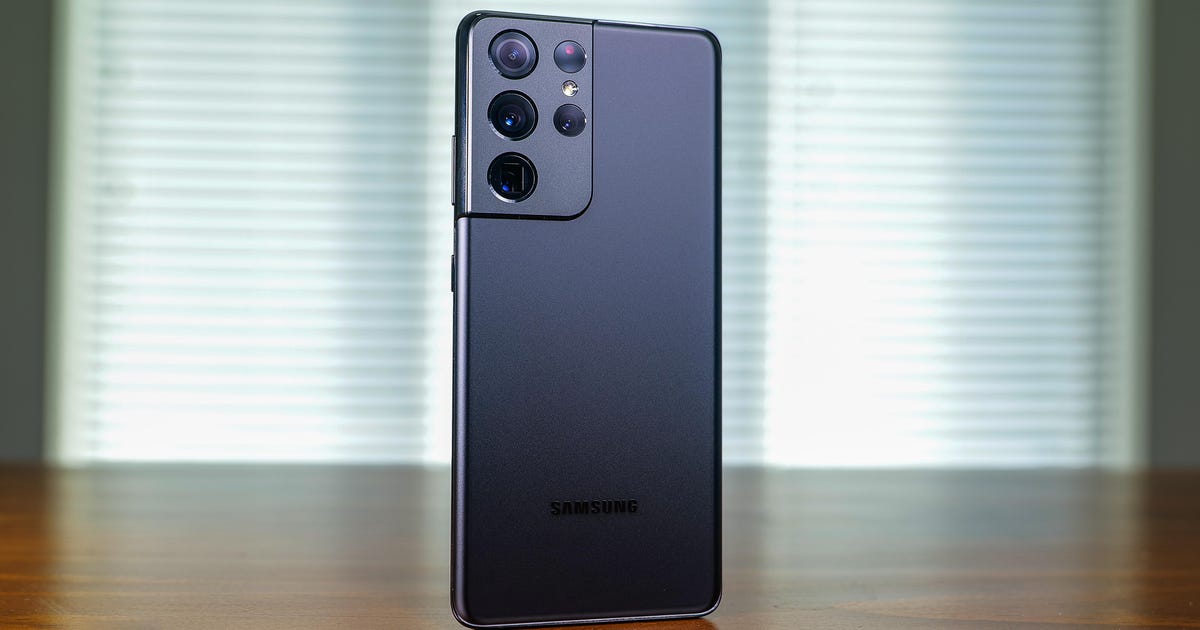
I wouldn't call the S21 Ultra's design radically different, but my review unit has the best black finish I've ever seen on a phone. It's the stuff that goth dreams are made of. The color is called phantom black, and seeing it in person makes you understand why Samsung made a nearly three-minute video explaining the blackest black finish. The S21 Ultra also comes in phantom silver and there are limited-edition phantom finishes in titanium, brown and navy, which can only be found on Samsung's website.
The camera bump is large and melts into the sides of the phone, which are glossy black. And while the regular S21 and S21 Plus looks snazzy in their two-tone colors, the all-black S21 Ultra is cool, elegant and badass all at the same time.
Read more: Galaxy S21 drop test: It broke on the first drop
The S21 Ultra is heavier than last year's S20 Ultra and the iPhone 12 Pro Max. It's the second heaviest phone I have tested in the past year, just behind the Asus ROG Phone 3.
The display is brighter and adds S-Pen support
Around the front is one of the most impressive displays I've seen. It has a Wide Quad HD resolution and a variable refresh rate between 10 and 120Hz, which is determined by what's on the screen. And just to be clear, it can be set to 120Hz without the hit to resolution that the S20 Ultra had. The 6.8-inch display is bright and the contrast is gorgeous. Covering the front and back is Corning's Gorilla Glass Victus.
Support for the S-Pen means you can draw, write, edit photos and sign documents on the S21 Ultra.
Sarah Tew/CNET
Under the screen is a larger ultrasonic fingerprint reader which feels peppy. I had a hard time telling if it was faster than the one on the S20 Ultra. The display also has S-Pen support.
The Galaxy Note phones line always tempted me, but I didn't think I'd use the S-Pen enough to justify getting one. I like the iPad Pro-Apple Pencil approach Samsung took with the S21 Ultra. Without an S-Pen, you can still enjoy using the S21 Ultra. But if you're S-Pen curious, you can buy a new S-Pen or find an old one and it will work. There's a lot you can do like draw, take notes and sign documents. I love editing photos and making adjustments with the S-Pen.
There are a few S-Pen considerations. The S21 Ultra doesn't come with an S-Pen and doesn't support Bluetooth or gesture functionality. For example, the S21 Ultra can't send you a notification if you leave your S-Pen behind. Also, the Ultra doesn't have a built-in slot to store an S-Pen. Samsung does sell cases for the phone that include S-Pen storage.
The S21 Ultra has two telephoto cameras
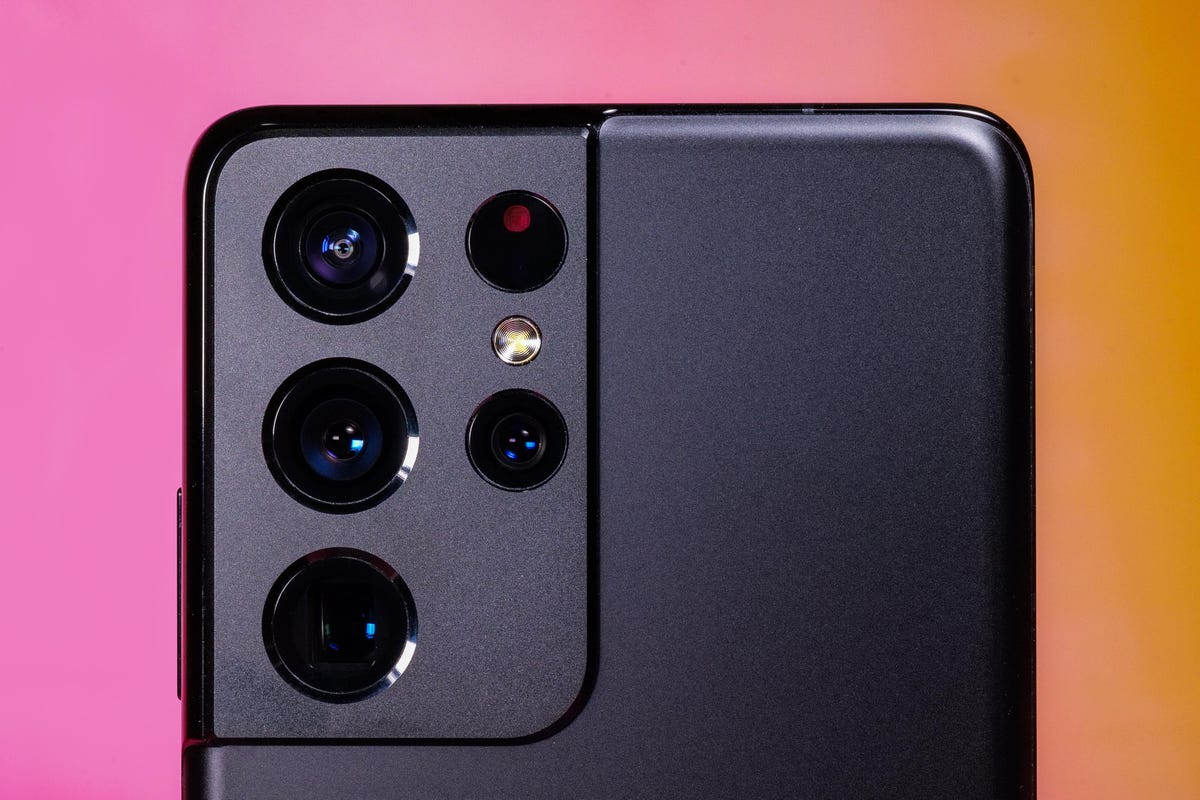
The S21 Ultra's camera system received several significant updates. There are four rear cameras: one wide, one ultrawide and two telephoto cameras. The time-of-flight sensor on the S20 Ultra is gone; in its place is a laser autofocus module.
The 108-megapixel sensor on the main camera is new and has better autofocus for both photos and videos. There's even a new focus enhancer tool that pops onscreen to help the phone focus faster. The tool looks like it might be switching to a wider view to do so.
Read more: S21 Ultra vs. iPhone 12 Pro Max vs. Pixel 5: Which phone has the best night mode?
There are four rear cameras: wide, ultrawide and two telephotos.
Patrick Holland/CNET
The dual-telephoto cameras add a number of benefits. One has 3x magnification and the other 10x. This means when you zoom in, there are two places in your zoom range where the image isn't cropped and where you'll capture the best image quality. Another benefit is stability. The two cameras are paired to help make zooming in, even at 100x, easier and more steady.
At 30x or higher, a zoom guide appears to help you find the specific spot that you're zoomed in at. You can lock it so the cameras don't move, which turns the guide yellow. This works quite well. Obviously you have to be careful not to move the phone around too much, but it's less finicky and frustrating than the S20 Ultra.
Photos from the S21 Ultra are excellent, with good detail and a wide dynamic range. There is a 108-megapixel mode, but I found that the 12-megapixel photos that come from pixel binning look consistently great.
Below are several photos I took with the S21 Ultra.
The main camera was set to 12 megapixels, which uses pixel binning to combine nine pixels into one.
Patrick Holland/CNET
One benefit of pixel binning is that it can bring out the details in a photo. Notice the different textures and details.
Patrick Holland/CNET
I used the single-take mode in the camera app to capture photos and videos of this cute dog. Here's one of the pictures my S21 Ultra chose.
Patrick Holland/CNET
There's so much for the S21 Ultra to capture correctly here: the barren tree branches, the water and the white fluffy clouds in the blue sky.
Patrick Holland/CNET
Here are three different photos I took from the exact same spot using the wide 1x camera (left), the 3x telephoto camera (middle) and the 10x telephoto camera (right).
Patrick Holland/CNET
In low light, the S21 Ultra's night mode is outstanding. Flaring on the lens is minimized and photos look bright without a bunch of image noise or noise-reduction smearing. Below are a few night mode photos I took:
This might be my favorite night mode photo of the bunch.
Patrick Holland/CNET
Here's another night mode capture. I like how the S21 Ultra brought out the colors in the sculpture.
Patrick Holland/CNET
Night mode on any of the S21 Ultra's cameras. I took this shot with the ultrawide.
Patrick Holland/CNET
For selfies there's the same 40-megapixel camera that the S20 Ultra had. You now have an option to change the color tone to either bright or natural which is excellent.
Here is a selfie I took with the natural setting.
Patrick Holland/CNET
Samsung added the ability to take raw 12-bit color photos. There's a new video feature called Director's View, which gives you a thumbnail preview of the video feeds coming from all of the cameras on the phones. As you record, you can switch between them. Within Director's View, there's a vlogger setup that gives you a side-by-side video view or a stacked one if you're shooting vertically. This means you can record yourself with the selfie camera and show what you're seeing or reacting to with any of the rear cameras.
On paper, Director's View seemed like something I might try once and not really use. But after some time using it, some people will definitely be into the feature. A downside to Director's View is that the final video is saved in HD instead of 4K or 8K. I'd love to see a similar thumbnail preview interface of all the rear cameras when recording a regular 4K video.
I'm excited to pit the S21 Ultra and its cameras against the iPhone 12 Pro Max and Google Pixel 5. Each phone takes a different approach to photography and will appeal to different people.
S21 Ultra has a Snapdragon 888 chip and 12 or 16GB of RAM
Powering the S21 Ultra is the new Qualcomm Snapdragon 888 chip, along with 12GB of RAM, or 16GB in the most expensive model -- which also has 512GB of storage (see the chart below for prices). In my benchmark tests, the S21 Ultra scored better than last year's S20 Ultra. And in use, it handled everything I threw at it, even playing Xbox Game Pass Ultimate games on it.
You can use the Xbox Game Pass Ultimate app to play Xbox games on your S21 Ultra.
Sarah Tew/CNET
Supplying juice to the phone is a 5,000-mAh battery. I've easily been averaging a day and a half on a single charge. Battery tests on the S21 Ultra for continuous video playback on Airplane mode clocked an average of 22 hours and 57 minutes with the refresh rate set to Auto 120Hz. That's actually an hour less than the S20 Ultra lasted in the same test. Though keep in mind, in real world use my colleague Jessica Dolcourt found the S20 Ultra's battery drained like it was being bitten by a "thirsty vampire."
Below are the results of my benchmark tests for the S21 Ultra.
3DMark Slingshot Unlimited
Note:
Longer bars indicate better performance
Geekbench v.5.0 single-core
Note:
Longer bars indicate better performance
Geekbench v.5.0 multicore
Note:
Longer bars indicate better performance
Android 11 and 5G support
The Galaxy S21 Ultra runs Android 11 with Samsung's OneUI 3.1 top layer. And I like it a lot. I can now default to Google Pay or Google Discover News feed instead of Samsung's versions. The look for everything from settings to pop-up windows is clean and contemporary. And with a phone this big, OneUI helps make it easier to use one-handed.
Last, the Galaxy S21 Ultra has 5G and supports both sub-6 and mmWave flavors of 5G. You shouldn't get the Ultra for its 5G. But as 5G networks get better, so will your 5G speeds and connection. And then we'll really have something to talk about.