Here is one of the pictures featuring the Apple Stock. Numerous images associated with the Apple Stock can be utilized as your point of reference. Below, you'll find some additional pictures related to the Apple Stock.
Apple's Swift Playgrounds 4 lets programmers submit apps to the app store
Apple's Swift Playgrounds 4 lets programmers submit apps to the app store
Apple on Wednesday released a major new version of Swift Playgrounds, its iPad and Mac app designed to teach kids its Swift programming language, that now lets budding coders submit their projects to Apple's app store.
Swift Playgrounds introduces programming by letting coders control a character named Byte. Programmers learn basics like commands, variables, loops, and if-this-then-that operations. The code they type is reflected immediately on a panel on the screen, letting them see immediately what their changes accomplish.
The Swift Playgrounds introductory lesson -- updated for Swift Playgrounds 4 -- expands to more challenging, elaborate tutorials. The new version also offers a broader set of detailed "walk-through" demo apps that students can scrutinize and copy to see how everything works.
You may not think programming is a necessary ability -- indeed, one point of Apple's products is to make digital technology useful even if you don't have a computer science degree. But the creativity and logical thinking skills it fosters are certainly useful in schools and work, and programming is an important career option.
Apple first released Swift Playgrounds five years ago as an iPad app, adding a Mac incarnation with the most recent version 3. Version 4 modernizes the tool significantly, starting with the iPad version. In addition to being able to submit apps to the app store, Swift Playgrounds also supports Apple's SwiftUI technology, a framework of user interface elements introduced in 2019 that helps bridge the gap between iPad, iPhone and Mac.
Being able to submit apps to Apple's app store doesn't guarantee the world will be able to try them. That's because Apple's usual app store review process applies. So don't expect your "hello world" experimental app to appear.
And to submit apps, programmers will need an Apple developer account, which costs $99 per year. Apple offers free accounts to schools, though.
Apple's Swift programming language is one of a new generation of languages like Rust from Firefox maker Mozilla (now run by the independent Rust Foundation) and Go from Google that are designed to make programmers more productive. These new languages are designed to do things like boost performance, avoid security problems and benefit more from hardware features like multicore processors that weren't common decades ago.
Swift Playgrounds also serves Apple's business interests, training people into becoming tomorrow's software developers and teaching them to use Apple's tools. Swift Playgrounds apps can be sent to Xcode, Apple's professional software development tool.
Even though Swift quickly caught on, its predecessor, Objective-C, remains widely used, according to the periodically updated chart of programming language popularity from analyst firm RedMonk.
Facebook parent to change stock ticker symbol toyota facebook parent to change stock ticker symbol tool facebook parent to change stock price facebook parent to change stock symbol facebook parent to change stock mufflers facebook parent meta responsible facebook parent portal general mclane facebook parents
Facebook Parent to Change Stock Ticker Symbol to META
Facebook Parent to Change Stock Ticker Symbol to META
Facebook parent company Meta Platforms said Tuesday that its stock will begin trading on the Nasdaq exchange under the ticker symbol META on June 9, replacing the FB symbol it went public with a little more than a decade ago.
The ticker symbol change comes roughly seven months after Facebook announced its rebranding to Meta to reflect the company's focus on building the metaverse, a virtual world where people can work, play, learn and connect with their friends and family.
At the time, Facebook announced it would start trading under the new stock ticker MVRS but later said it would delay the change until the first until the first quarter of this year.
Roundhill Investments had used the META stock symbol for its Roundhill Ball Metaverse ETF but relinquished it in January, allowing Meta to take over ownership.
The change comes at a challenging time for the social networking giant. In February, the company reported disappointing fourth-quarter earnings and a drop in daily users, underscoring how much it relies on social media, though it did see a rebound in the first quarter of this year. Facebook founder Mark Zuckerberg has noted other challenges facing Meta, including Apple's privacy changes, regulation and the war in Ukraine.
Samsung galaxy s20 fe comparison samsung s20 fe cheapest price how much is samsung galaxy s20 lowest price samsung s20 least expensive samsung galaxy phone least expensive samsung phone least expensive samsung smartphone least expensive samsung phone samsung phones cheapest to most expensive samsung s21 samsung s23 samsung stock
Samsung's less expensive Galaxy S20 FE is 'very much a response' to the pandemic
Samsung's less expensive Galaxy S20 FE is 'very much a response' to the pandemic
Samsung has another Galaxy S20 for its fans, and the device has been tailored for our unusual times. The Galaxy S20 Fan Edition, also known as the Galaxy S20 FE, packs some high-end features found in the rest of the S20 lineup -- like low-band 5G connectivity -- but at a starting price of $700 (£699, AU$999). That's $300 less than the regular Galaxy S20 -- and you can currently get it for $100 less. Adding superfast millimeter wave 5G connectivity for the Verizon model brings the price up to $750 (though the carrier is currently offering a promotional $50 discount).
The 6.5-inch S20 FE has the same Snapdragon 865 processor as the rest of the lineup and includes IP68 water resistance. It sports three rear camera lenses, including a 30x Space Zoom like what's featured in the S20 and S20 Plus. It's available in six bright colors. One of the device's biggest differences from the rest of the lineup: The back is made of plastic instead of glass.
Read more: Galaxy S20 FE vs. other S20 phones: How is the new Fan Edition so much cheaper?
Samsung, which unveiled the FE during a virtual Unpacked event, hopes to attract people who shy away from a $1,000 phone but still want the flashier features of the company's Galaxy S lineup. And it's those people who want that Galaxy S brand instead of the cheaper, simpler Galaxy A devices. During the coronavirus pandemic, that could turn out to be a lot of potential buyers.
"It's very much a response [to the pandemic]," Drew Blackard, vice president of product management for Samsung Electronics America, said in an interview ahead of the news. "We've seen the need for a really more value-segmented offer that focuses on those core features that we know our users love the most and prioritize the most."
The company had considered introducing a device that fell between the A Series -- which ranges from $110 to $650 in the US -- and the bottom end of the S Series, which starts at $999, Blackard said. It's done something similar in the past, like introducing the $650 Galaxy S10 Lite in January at CES 2020.
But the pandemic caused Samsung to speed up the FE's development and release, something it could do because it controls many parts of its supply chain. The FE, which goes on sale in the US on Oct. 2, arrives about seven months after the other S20 phones hit the market, whereas the S10 Lite became available in the US over a year after its siblings went on sale.
"One of Samsung's core advantages and competitive advantages in the market is speed," Blackard said. "We can very quickly design new products and get to market."
Samsung, which lost its crown as the world's biggest phone maker to Huawei in the second quarter, has been introducing its new devices in a difficult environment. Instead of facing a strong market for phones, with 5G and foldable screens getting people to upgrade their devices, most handset makers are seeing reduced demand amid the raging novel coronavirus pandemic. Nearly a million people have died, over 31 million have been infected and millions more are out of work, unsure when they'll next earn a steady paycheck.
While tech overall has seen a spike in demand during the pandemic, the phone market has struggled. Consumers are opting for less expensive devices, saving their money altogether or spending their cash on PCs and other work-from-home and entertainment supplies. This year, smartphone sales are expected to hit a 10-year low because of the pandemic, according to CCS Insight.
Samsung, despite launching its new Galaxy S20 lineup in March and its less expensive Galaxy A phones over the following months, saw the biggest year-over-year drop of the world's top five phone makers in the second quarter, Canalys said. Samsung's 30% decline allowed Huawei to leapfrog it to become the world's biggest smartphone vendor for the first time, Canalys noted. It was the first time in nine years that a company other than Samsung or Apple shipped the most phones.
Samsung now hopes the S20 FE will help turn things around.
"The new Galaxy S20 Fan Edition is ideal [for the current environment]," said Avi Greengart, an analyst at Techsponential. "It gives people differentiated features … all at a price people are looking to pay."
Pandemic problems
Samsung was counting on this year's Galaxy S20 lineup -- its first crop of phones that all feature 5G connectivity in the US -- to woo buyers who'd been waiting to upgrade their devices. Then COVID-19 swept across the globe. The US went into lockdown about a week after Samsung's Galaxy S20 lineup hit stores. Because consumers were worried about money -- and couldn't see the new devices in person -- demand fell. In July, Samsung said its mobile business revenue tumbled 18% from the previous year.
In the US, Samsung sold about 44% fewer Galaxy S20 models in the first four months of sales than the Galaxy S10 last year, according to M Science, a data analytics provider that tracks stats like mobile adoption.
The Galaxy S20 FE comes in six colors, including Cloud Mint.
Samsung
What Samsung has found is that its less expensive S20 model has attracted the most buyers in recent weeks. In a normal year, it's the priciest Galaxy S or Note phone that sells in the highest numbers, at least at first, Blackard said. About six to eight weeks later, after the megafans have made their purchases, the lower-end models sell better.
That happened this year but in a more pronounced way, Blackard said. The Galaxy S20 Ultra was the top-selling device of the lineup at launch, he said, just as the Note 20 Ultra surpassed sales of the cheaper Note 20. But then the less expensive models became more popular.
"Within the first six to eight weeks [after] launch, you start to see that transition happen," Blackard said. "And in this case, it just happened more sharply than it did the year before."
Cheaper is king
Phone-makers have responded differently to the pandemic. In the case of Apple, it likely developed the iPhone SE well before the coronavirus spread widely, but its launch timing proved to be fortuitous. At $399, the SE is the cheapest new phone in Apple's lineup, and it includes a feature that's perfect for the times: a Touch ID fingerprint reader. That makes it easier to unlock the device while wearing a mask, versus the Face ID technology in Apple's pricier phones.
That device helped Apple report strong financial results, even as the company delayed its high-end iPhone 12 lineup, in part because of pandemic-related production issues. Instead of arriving in September, as iPhones normally do, the devices will likely launch in October.
Samsung's answer to the iPhone SE was its Galaxy A lineup, a batch of devices available overseas for years but arriving in the US for the first time. The four new 4G LTE models ranged from $110 for the Galaxy A10 to $400 for the Galaxy A51. Samsung even introduced two 5G devices, the $500 Galaxy A51 5G and the $600 to $650 Galaxy A71 5G, giving the South Korean company two of the cheapest 5G phones in the US.
The Galaxy S20 FE falls more in line with Apple's iPhone 11. It's part of the premium range but lower in price. The iPhone 11 has been one of Apple's top sellers over the past year.
Xiaomi mi 4 review xiaomi s mi 4 flagship phone definition xiaomi mi 4 review xiaomi s mi 4 flagship one xiaomi mi 4 review xiaomi s mi 4 flagship car xiaomi mi 4 review xiaomi s mi 4 cast xiaomi mi 4 review xiaomi s mi 4 digit xiaomi mi 4 review xiaomi store xiaomi mi 4 review xiaomi note xiaomi mi 4 review xiaomi 11t xiaomi mi smart band 4 review xiaomi mi band 7 xiaomi mix 2s xiaomi mix alpha
Xiaomi Mi 4 review: Xiaomi's Mi 4 flagship phone innovates on the iPhone design (hands-on)
Xiaomi Mi 4 review: Xiaomi's Mi 4 flagship phone innovates on the iPhone design (hands-on)
BEIJING -- It's not the first time we've seen Xiaomi pull off an Apple-inspired design, so the look of the newest Xiaomi Mi 4 shouldn't be too surprising. For one, the recently announced Mi Pad borrowed elements of the iPad Mini and the iPhone 5C, while its Mi WiFi Mini router resembles the Apple Magic Trackpad.
The Mi 4, the company's new Android flagship phone, borrows its style heavily from the iPhone 5S, but the Chinese company has added its own touches to the design with a removable rear cover and a larger 5-inch display.
The 1,999RMB smartphone will be available in China for 1,999RMB (which converts to $320, £190, AU$345) for the 16GB model and 2,499RMB (which converts to $400, £235, AU$430) for the 64GB version at the end of the month, while the 4G version (TD-LTE, for China) will launch in September. There's no word yet on global availability.
Design and display
As mentioned, the Mi 4 takes a lot of design cues from the iPhone 5S. The stainless steel frame around the edges is similar to those on the iPhone, though the button placements are opposite each other. The phone looks completely different from the previous Mi 3 flagship, which looked more like a Nokia handset.
Aloysius Low/CNET
The stainless steel frame holds the phone together.
Aloysius Low/CNET
It's hard not to think of the phone as a clone of the iPhone, but Xiaomi has added its own touches. Instead of going with onscreen keys like some of the recent Android phones, the Mi 4 still keeps the old-school style of the back, home and menu buttons.
These touch sensitive buttons light up when depressed, and fade away to be hidden from sight when not in use. Perhaps it's a better design decision to use onscreen keys instead, after all.
Despite its 5-inch full-HD display -- which only has a 1,920x1,080-pixel resolution -- the phone is incredibly light at a mere 149g. In comparison, the iPhone 5S weighs 112g, but is much smaller in size.
Unlike the iPhone's metallic rear, the Mi 4 comes with a swappable cover, in a bunch of varied designs. If you like Samsung's faux leather rear, Xiaomi has something similar. If you liked the Moto X's wood covers -- you guessed it -- Xiaomi also has one. And if your taste has no boundaries, there's also a marble-looking cover, for moments when you need your phone to match your floor.
Aloysius Low/CNET
Specs and software
Internally, Xiaomi's Mi 4 comes packing what you'll find in most flagship phones. It's powered by a 2.5GHz quad-core Qualcomm Snapdragon 801 processor, has 3GB of RAM and comes with either 16GB or 64GB.
More importantly, Xiaomi has managed to squeeze a 3,080mAh battery into the phone's 6.7mm-slim frame, which should easily last you a day or more. There doesn't appear to be a microSD card slot, and the phone seems to still cater to the older large SIM cards.
On the rear is a 13-megapixel camera while there's a front 8-megapixel shooter for taking detailed selfie shots. The rear has a six-element lens while the front uses five-elements. Both cameras have a f1.8 aperture. Xiaomi also demoed an image refocusing capability similar to that found on the LG G3 and Samsung Galaxy S5.
Aloysius Low/CNET
The Mi 4 runs MIUI on top of Android KitKat (4.4.3), and is likely to be v5. While Xiaomi has announced a new upcoming v6 that will debut on August 16, the phone likely isn't running it as it will go on sale at the end of July in China. A quick check of the phone's MIUI version shows that it's running MIUI 4.7.20, but the last major release for v5 was 4.6.27 in June.
Outlook
With Xiaomi's CEO Lei Jun publically stating at the event that the company has enough facilities to ensure stock availability, the new Mi 4 could quickly launch in other regions outside of China after its local launch. Furthermore, the Xiaomi boss was quick to downplay the 4G version at the press conference, possibly due to the fact that if users wait for the LTE model, sales of the 3G-only model would be affected.
Given the popularity of the Chinese company's phones, however, that's unlikely to happen, especially as the phone is so reasonably priced for a high-end device. Given that Xiaomi's competition, such as Oppo, already have 4G-capable devices ready for an international market, Xiaomi will have to work harder to get the 4G version of the Mi 4 to the more mature markets, such as Singapore.
While the Xiaomi Mi 4 is one of the best phones to come out of the company yet, Apple's likely to launch a new model of its handset soon, and Xiaomi's design may feel a little dated once that's released.
Take Better Vacation Photos: 7 Tips From a Travel Buff
Take Better Vacation Photos: 7 Tips From a Travel Buff
Here's a secret: You don't need an expensive camera to get great photos. Sure, it can help, and there are some photos only a "real" camera can take. However, you might be surprised at how good your photos can be just using your phone or an inexpensive camera. Learning these tips and techniques will help you if you ever upgrade to a big camera too.
Who am I to give this advice? I'm a travel writer and photographer, with over 150 photo galleries here on CNET taken all over the world. I have an expensive camera, sure, but I also use my phone more than you'd expect.
There's an overused, but still true, adage: The best camera is the one you have with you. So if you can get photos you like without spending money on a camera you might only use once or twice a year, even better.
While each phone is slightly different in its hardware and camera app, I've kept the following tips general enough that they should work on just about every device. More expensive phones can generally take higher quality images than cheaper phones, but you should be able to get great results no matter what you have. Also, if you're confused by any of the terminology, there's a glossary of some often-used camera terms at the bottom.
For more, here's how to take great vacation videos with your phone camera and some tips for getting great shotseven if your phone is old. Plus, here are the seven things you should always pack when you travel and what travel veterans recommend before leaving on vacation.
1. Clean the lens
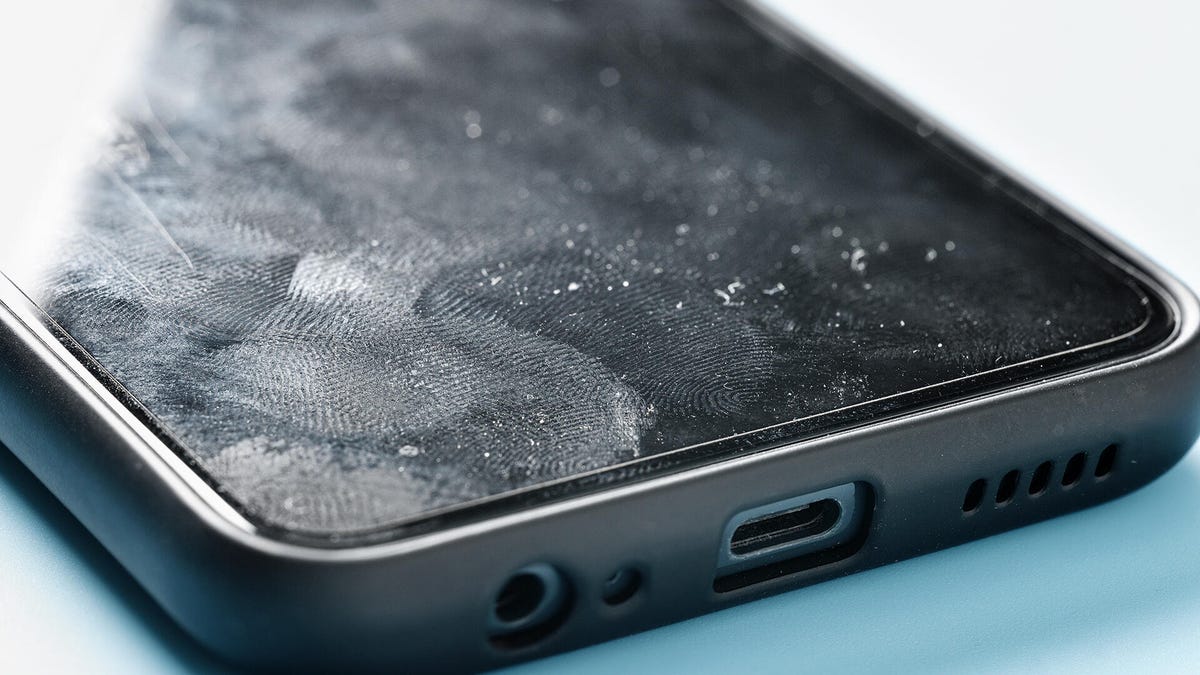
Does your phone screen look like this? I bet the camera does too. Few things can improve the quality of your photos more than a clean camera lens.
Serhii Shleihel/GettyImages
I can't stress enough how important this is. Well, I guess I can stress it since I'm putting it first. I'm amazed how often I see washed out and smudged images that are the result of fingerprints or other schmutz on the camera lens. Just cleaning your lens will improve the quality of your images probably more than any other tip.
How often? I literally check my camera lens before every group of photos. Important ones, anyway. Phone comes out of my pocket, I check the camera lens.
Ideally, you'll use a microfiber cloth, the same sort that comes with glasses/sunglasses. If not, even a soft shirt will be fine. Nothing rough or coarse. Nikon sells a nice microfiber cloth that comes in its own tiny neoprene baggie. This keeps it clean and conveniently on hand.
If you have a real camera, always (always always always) use a lens cap. I get such anxiety when I see people pull a camera from a bag, or have it dangling around their neck, and there's no lens cap. Scratches are even worse than smudges since they permanently decrease the image quality possible with the lens. Lenses are the eyeballs of your camera. Treat them as such.
If you're worried about losing your lens cap, or hate juggling it while you're handling your camera, check out cheap lens cap straps. They're great.
2. Tap the screen
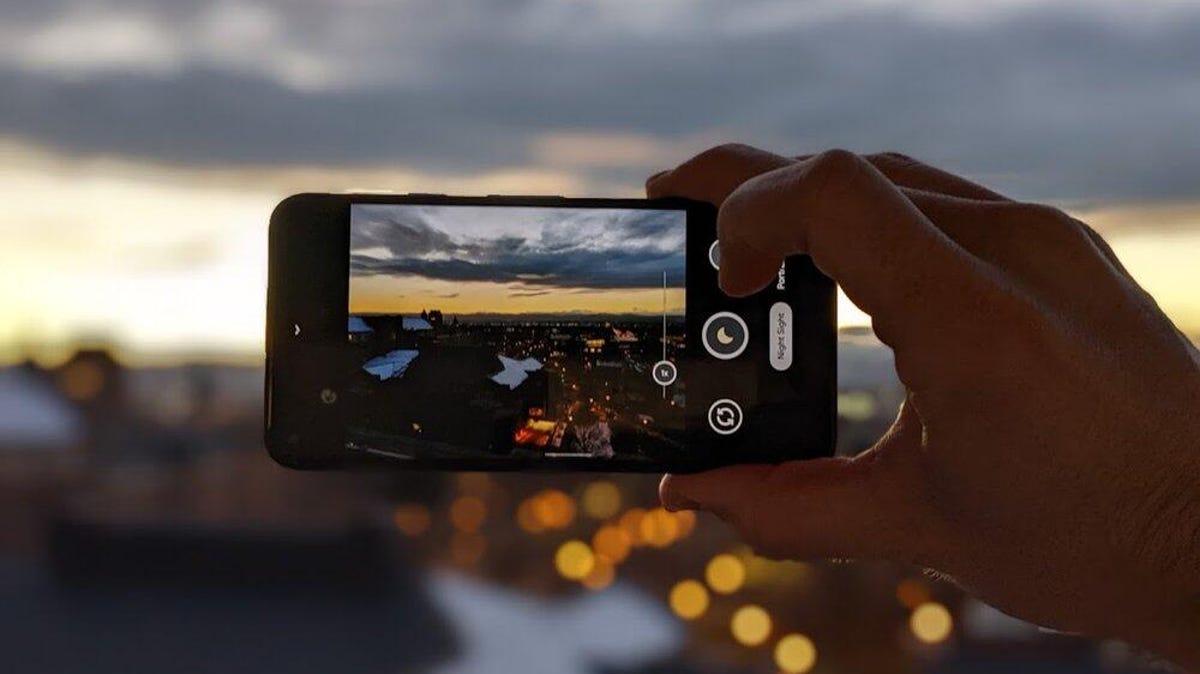
The camera app on a Google Pixel
Google
This always seemed obvious to me, but I've regularly caused "ah-ha!" moments giving this advice. When lining up your shot, if it doesn't look right, tap the screen. Most phones are pretty good at figuring out what you're trying to photograph, but not always. Tapping on your subject, a person, animal, thing, whatever, and changes the focus and exposure.
Here's an example. Say you want to take a photo of your partner on the beach at sunset. Three beautiful things in one photo: partner, setting sun, ocean. The beach too I suppose unless you don't like sand. This is called a backlit photo, and it's extremely hard to do. Most often, your partner will be underexposed (see the terminology section below), as in they'll look dark/shadowed.
With most phone and camera apps, you can tell the camera where to expose the image. In this case, on your partner. The sun will then be overexposed (blown out), but you'll still get the idea it's a sunset and you'll be able to see your partner, which is generally the point, right? If your phone is able to take HDR photos, this image will look better than if it can't.
There is some editing you can do to make a photo like this look better, but that can only go so far. We'll get to editing a little later.
3. Don't use the flash
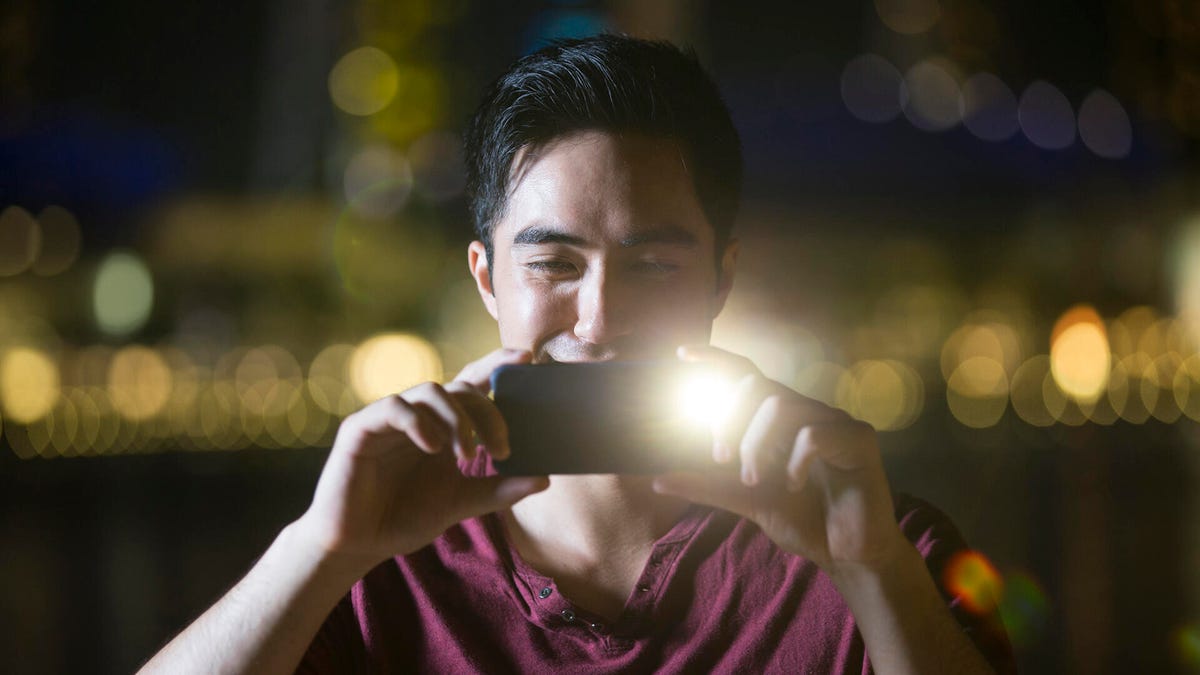
If you're this close to your subject, sure, try the flash. Most phones and cameras have decent low-light capabilities, so the image might look better with the flash turned off. It's worth checking.
Jenner Images/Getty Images
There's no such thing as a good camera flash on a phone. They're all terrible. Even the big add-on flashes for full-size cameras only work in certain situations. Believe it or not, in most cases you'll get a better photo turning the flash off completely. Not 100% of the time, however, so it's worth trying both options.
This is especially true if you're using a full-size camera with built-in flash. In every scenic place I've ever been there's at least one person trying to take a landscape photo and their flash fires. Flashes, even the best, only work within a few feet of the subject. Not only will they do nothing for landscapes, they'll wear down your battery faster at best, and mess with the exposure at worst.
You can turn off the flash in your camera app's settings. More on that below.
There is such a thing as a Slow Sync Flash photography that can be great when trying to photograph people in front of a twilight or night landscape. I'd classify this as a bit more advanced, but with a bit of practice the results can be great!
4. Get a selfie stick
Grandma's gonna find that reindeer and enact revenge.
Geber86/Getty Images
Selfie sticks are good. I have apishly long arms and I still have one, though I typically use it for my 360 camera. My 80-year-old dad has one. They're great. People should take more photos of themselves, of their family and friends, everything. I honestly don't get the hate. Photos are great! Preserve whatever memories you can. Future you will thank you.
To put it more pragmatically, a selfie stick will let you get a wider field of view of yourself, the people you're with and where you are. It just makes for a better photo.
When you're using them, certainly be wary of your immediate surroundings and the people near you. Some locations, especially crowded or dangerous ones, tend to restrict selfie stick usage. Keep an eye out for signage.
If you're not sure how much you'll use it, there's this $8 option on Amazon that extends to 28.7 inches, has a Bluetooth remote built in, and has a base that extends out into a tripod. It collapses down quite small too. For something a bit more elaborate and sturdy for an action camera, GoPro's own 3-way 2.0 configures to a wide variety of positions and angles. It's made for their cameras, of course, but many action cameras use the GoPro-style mount.
5. Get a better angle
This is Smeagol and he is a Very Good Boy.
Geoffrey Morrison/CNET
Most people just bring the phone or camera up to eye level and take the photo. Sometimes that's fine, but you can often get far better results with a different angle. Try holding the camera above your head and aim down. Photographing people from below tends to be rather unflattering, but slightly above often looks great. If you're taking a picture of a kid or animal, get down to their level. A dog's-eye-view of a dog is almost always a more interesting photo than a human's-eye-view of a dog.
This is an aspect where a selfie stick helps. Extend it out and you'll be able to easily frame that epic photo of you and the fam at the Grand Canyon where you can see you, the fam, and the Grand Canyon instead of you, parts of the fam, and a sliver of the Grand Canyon.
6. Learn your app's settings and modes
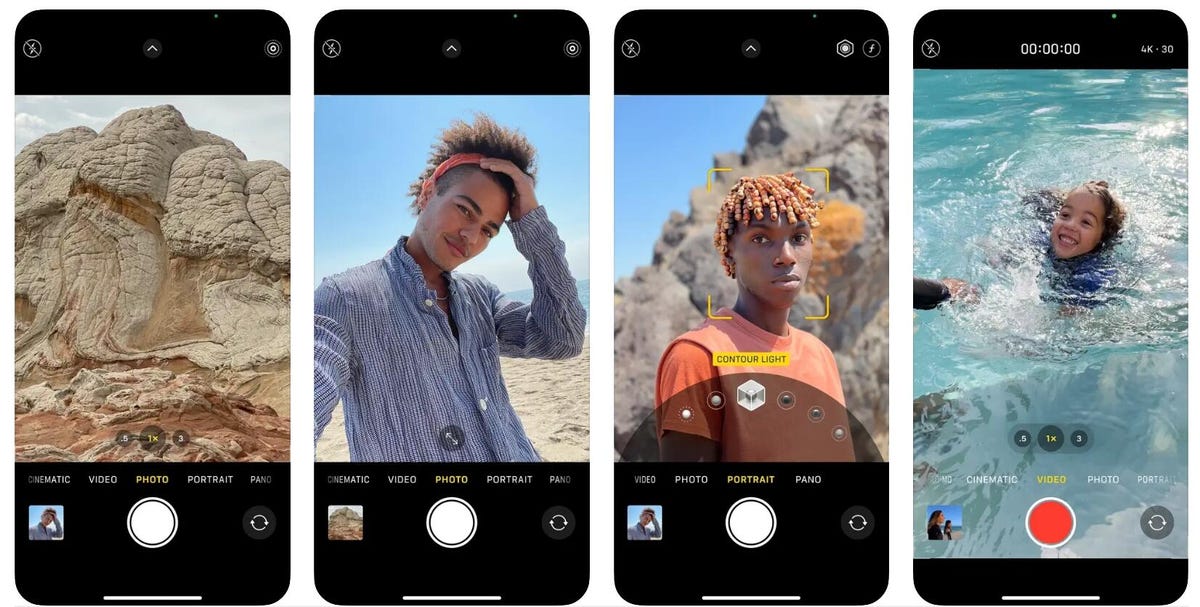
Changing the default settings on your phone's camera app can have big results.
Apple
Nearly every phone's camera app is capable of a variety of different photo styles. I'm always surprised to see how many people have no idea. Portrait mode, landscape mode and night mode all let you take vastly more interesting photos than the basic mode, all with just a few taps on the screen. Check them out, see what they do.
As far as settings go, generally the stock ones should be fine. It's worth checking to make sure it's taking the highest-resolution it can and that the flash is turned off (see No. 3). Some apps let you shoot RAW, more info on that in the terms section below.
I'd also recommend enabling manual controls, if available. They'll just take a few minutes to learn and they should help you get the photo you want when, like described in No. 2, the camera itself is struggling to do so.
Fun fact: Many camera apps have the option to use one of the phone's buttons as the shutter. If it's too hard for you to tap the screen while holding the phone, perhaps using the volume button instead will be easier. There are also timer functions that give you a countdown of a few seconds to get your pose and people ready.
Read more: How to Use the iPhone's ProRaw Mode to Make Your Photos Look Better Than Before
7. Editing
Note the different editing possibilities cycling through on the right.
Google
Nearly every great digital photo you've ever seen has gone through some amount of editing. Colloquially this is called "Photoshopping" but you don't need to pay Adobe for a subscription to that specific program. In fact, there are a lot of free options. Your phone might have some built in to its gallery already. Instagram has some great adjustments too. Beyond those, check out CNET's best free and paid photo editing apps for iPhone and Android.
The easiest way to learn is to just pick a photo and see what all the options do. Visually, it will be pretty obvious what things like contrast, brightness, and so on actually do. Most of them do the same thing on your TV, if you're interested.
Slight tweaks to contrast, brightness, and color will do wonders for any image. You can "slap a filter on it," sure, but starting with a better base image will usually make it look better after you apply a filter too.
Bonus! Cloud backup
Ymgerman
While not a camera tip per se, I very strongly recommend getting some sort of cloud backup for your photos. Integrated with your phone this means that whenever you're on Wi-Fi all your photos will get backed up to the cloud. With a real camera you can download them to the camera's phone app, and usually they'll get sent to the cloud from there. Sometimes, like with GoPro, there's an extra step required to save them to your phone's gallery.
With a cloud backup if you lose your phone or camera, you won't lose your photos. This saved me in a big way when I got robbed on an overnight train in Italy, and another time when a hard drive crashed on me.
Also, never forget, there are only two types of hard drives: Those that have failed, and those that will fail.
Check out our six ways to keep your photos safe in case of an emergency and best cloud storage services for 2022.
When to upgrade
As you get to know your phone's camera, you'll start to find its limitations. A limited zoom is going to be the most obvious, followed by noise in the image, a lack of settings, and so on. Some of you will start wanting more. It's a logical progression, one I bounded through myself, from inexpensive options to more and more expensive options. It's a pricey hobby, to be sure. Buying used can help.
I recommend checking out my Best Camera for Summer Travel article as a next step. It's aimed towards vacation/travel options, but should give you an idea what's out there and what the upgrade steps look like.
Terms and words and stuff
You'll find these terms when reading about actual cameras, as well as about phone cameras and within apps.
Wide angle: A type of lens that typically captures more than what you'd see with your eyes in one glance. The whole forest instead of a single tree, so to speak.
A wide angle photo, taken with my phone, of the Root Glacier in Wrangell-St. Elias National Park. Note the tiny people in the lower left.
Geoffrey Morrison/CNET
Telephoto: The tree, not the forest. Telephoto lenses let you capture images where you seem right up close to a subject but were actually far away.
Standing in the same place as the above photo, but with a 135mm telephoto lens on a Canon R6. These are the same hikers, a few minutes earlier, as they made their way across the glacier. Note how much closer they seem.
Geoffrey Morrison/CNET
SLR/DSLR: Single Lens Reflex/Digital Single Lens Reflex. Historically the "big, real camera." Usually a shorthand for a camera where you can change the lenses. Gradually being replaced, even among expensive cameras, with mirrorless versions.
Mirrorless: Lacking the moving mirror found in all SLR/DSLR cameras. What this means for you is the cameras are slightly smaller and lighter. Offered in a wide variety of prices. At the top end they're replacing professional DSLRs.
35mm equivalent: Refers to 35 millimeter film, the old standard, as a way to describe how wide, or telephoto, a lens is. For example, a 35mm-equivalent 12mm lens is wide, a 100mm lens is telephoto. Used as a relative reference since the actual focal length will vary depending on the size of the image sensor.
Optical zoom: This is the only real zoom. Uses glass or plastic lenses to make a subject appear closer.
Digital zoom: Best to think of this as "fake" zoom. It merely crops the image, and then upconverts it. Doesn't make the subject more detailed, just larger. OK if there's no other option, but the image quality is vastly inferior to optical zoom.
Underexposed: A subject or image that's darker than desired.
Overexposed: A subject or image that's brighter than desired.
RAW: An image format that's just very lightly processed data from the image sensor. At the professional level, RAW files are used almost exclusively as there is more range available to edit. However, you need to be knowledgeable with photo editing and have an app/software that can edit your camera/phone's RAW files. Not for beginners.
As well as covering TV and other display tech, Geoff does photo tours of cool museums and locations around the world, including nuclear submarines, massive aircraft carriers, medieval castles, epic 10,000-mile road trips, and more. Check out Tech Treks for all his tours and adventures.
He wrote a bestselling sci-fi novel about city-size submarines, along with a sequel. You can follow his adventures on Instagram and his YouTube channel.