Here is one of the pictures featuring the Apple Support. Numerous images associated with the Apple Support can be utilized as your point of reference. Below, you'll find some additional pictures related to the Apple Support.
Apple air ipad 1474 latest version of apple ipad air apple ipad air latest version ipad air 4th generation 256 new apple air ipad apple ipad air 4 64 ipad air version 4 apple announces new products
Apple announces new $499 iPad Air and $399 iPad Mini, both with Pencil support and faster A12 processor
Apple announces new $499 iPad Air and $399 iPad Mini, both with Pencil support and faster A12 processor
One week before it's expected to lift the curtain on a long-rumored video streaming service at an event on March 25, Apple announced two new iPads.
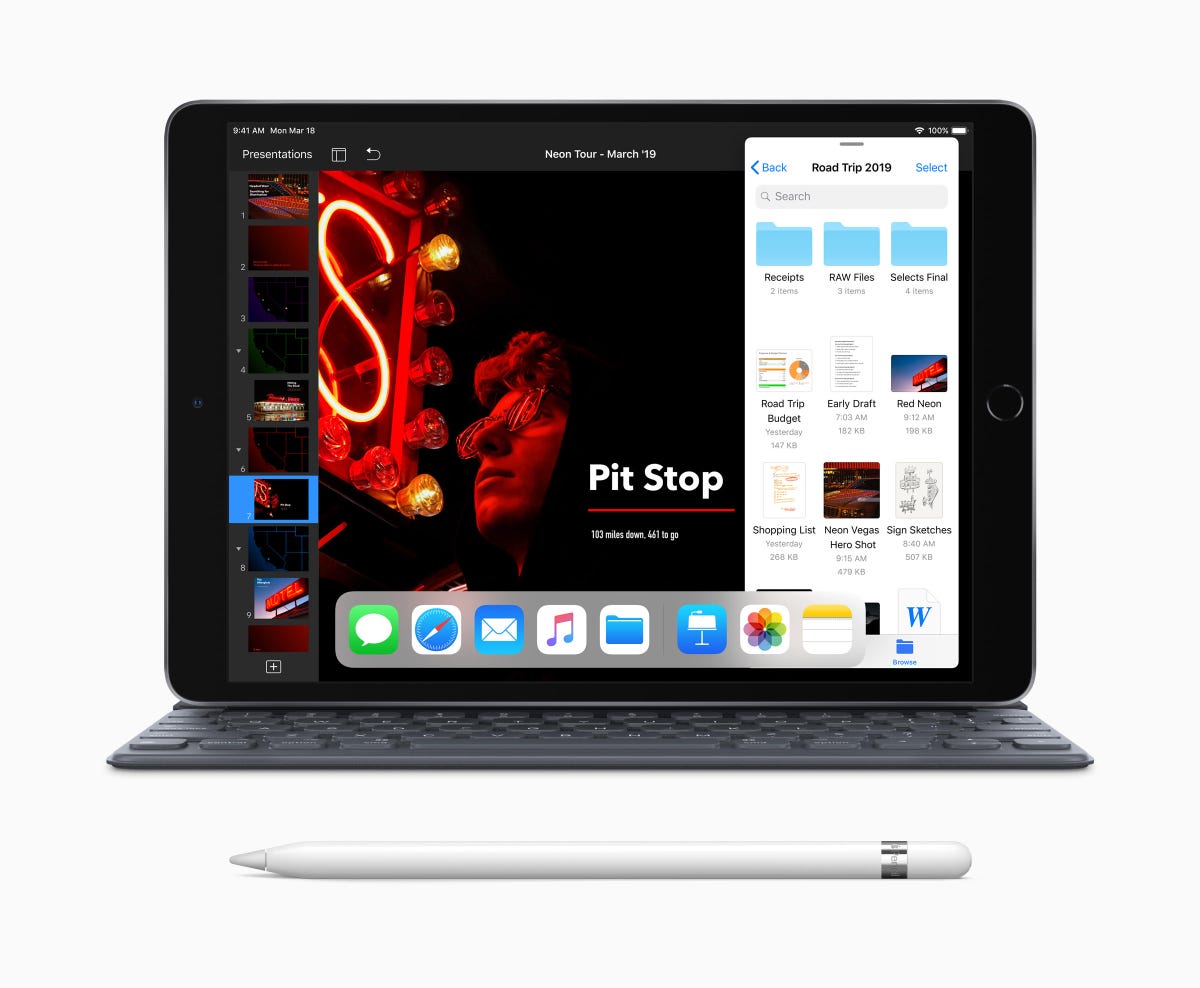
Starting at $499 (£479, AU$779), the new iPad Air features a 10.5-inch Retina display and the same A12 Bionic processor used in the iPhone XS. The new $399 (£399, AU$599) iPad Mini will replace the aging iPad Mini 4, which had been left virtually unchanged by Apple since its debut in 2015. The new models are now available for preorder and will be in stores next week. See the buying links below, and note that CNET may get a share of revenue from the sale of products featured on this page.
The 2019 iPad Air
The new iPad Air sits between the 9.7-inch iPad introduced last year, which starts at $329, and the 11-inch iPad Pro, which starts at $799 and has a more powerful A12X processor. The new Air is essentially a refresh of the 10.5-inch iPad Pro from 2017, which Apple has now discontinued. It has a nearly identical design -- and accessories will be interchangeable between the two -- but a few newer components. Apple hadn't released an "Air" version of the iPad since switching over to the plain old "iPad" in 2017.
The new iPad Air with Apple's smart keyboard and Pencil.
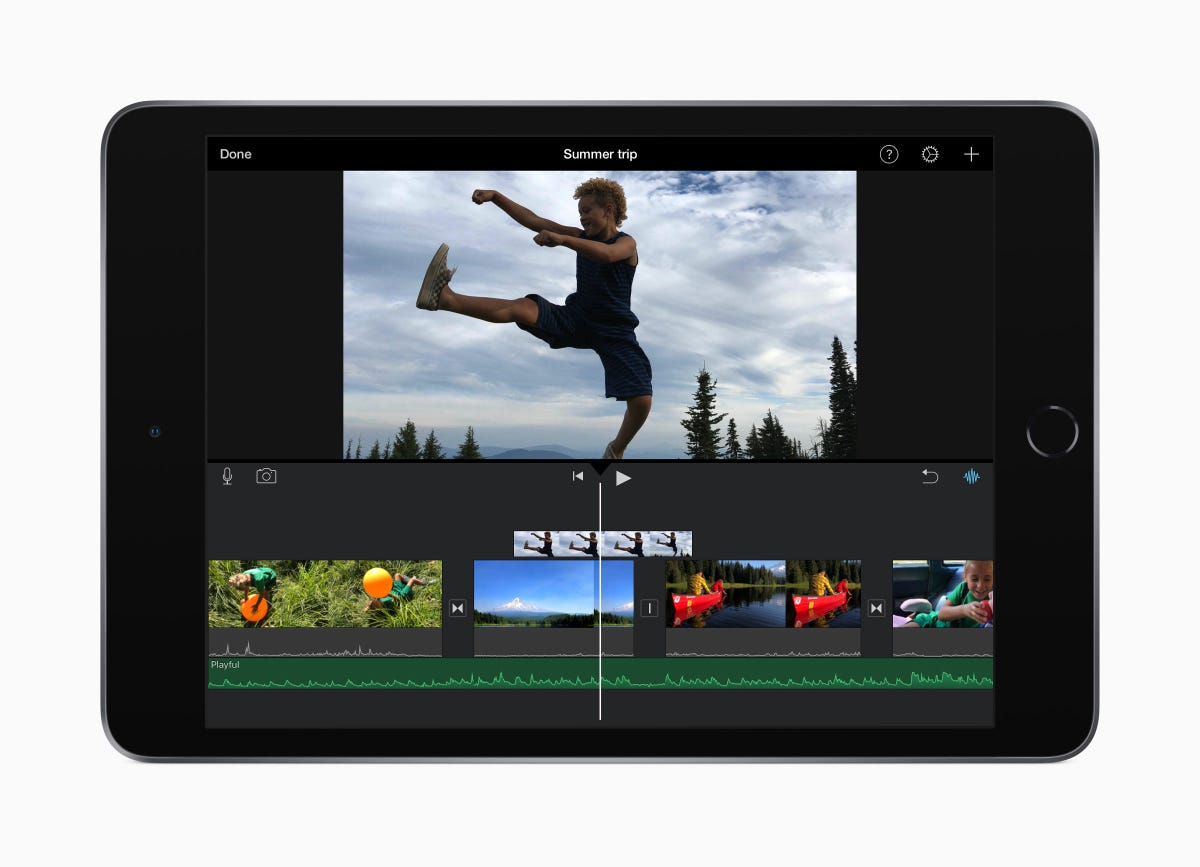
The new iPad Mini has the same basic design as the iPad Mini 4, with the same 7.9-inch display and the same broad bezels. (The camera has moved to a different position, however, so Mini 4 cases may not fit properly on the new model.) The new Mini doesn't have Face ID or USB-C ports -- major upgrades found on other recent Apple tablets -- though it has a much faster A12 processor. That chip will surely give the new model a significant performance advantage over its predecessor, which used the same A8 chip as the 2014-era iPhone 6. The new model retains the previous model's 3.5mm headphone jack and Lightning port -- two features that Apple excluded from last year's batch of iPad Pros.
Apple often introduces new products in March. At last year's event, Apple delivered a refreshed edition of its entry-level iPad in addition to some education-friendly software initiatives. That today's announcement was made by press release suggests that the company wants to keep the focus of next week's event solely on its new video streaming service.
Originally published March 18 at 6.39 a.m. PT. Update, at 11.05 p.m. PT: Added more details about accessory compatibility.
Apple's Swift Playgrounds 4 lets programmers submit apps to the app store
Apple's Swift Playgrounds 4 lets programmers submit apps to the app store
Apple on Wednesday released a major new version of Swift Playgrounds, its iPad and Mac app designed to teach kids its Swift programming language, that now lets budding coders submit their projects to Apple's app store.
Swift Playgrounds introduces programming by letting coders control a character named Byte. Programmers learn basics like commands, variables, loops, and if-this-then-that operations. The code they type is reflected immediately on a panel on the screen, letting them see immediately what their changes accomplish.
The Swift Playgrounds introductory lesson -- updated for Swift Playgrounds 4 -- expands to more challenging, elaborate tutorials. The new version also offers a broader set of detailed "walk-through" demo apps that students can scrutinize and copy to see how everything works.
You may not think programming is a necessary ability -- indeed, one point of Apple's products is to make digital technology useful even if you don't have a computer science degree. But the creativity and logical thinking skills it fosters are certainly useful in schools and work, and programming is an important career option.
Apple first released Swift Playgrounds five years ago as an iPad app, adding a Mac incarnation with the most recent version 3. Version 4 modernizes the tool significantly, starting with the iPad version. In addition to being able to submit apps to the app store, Swift Playgrounds also supports Apple's SwiftUI technology, a framework of user interface elements introduced in 2019 that helps bridge the gap between iPad, iPhone and Mac.
Being able to submit apps to Apple's app store doesn't guarantee the world will be able to try them. That's because Apple's usual app store review process applies. So don't expect your "hello world" experimental app to appear.
And to submit apps, programmers will need an Apple developer account, which costs $99 per year. Apple offers free accounts to schools, though.
Apple's Swift programming language is one of a new generation of languages like Rust from Firefox maker Mozilla (now run by the independent Rust Foundation) and Go from Google that are designed to make programmers more productive. These new languages are designed to do things like boost performance, avoid security problems and benefit more from hardware features like multicore processors that weren't common decades ago.
Swift Playgrounds also serves Apple's business interests, training people into becoming tomorrow's software developers and teaching them to use Apple's tools. Swift Playgrounds apps can be sent to Xcode, Apple's professional software development tool.
Even though Swift quickly caught on, its predecessor, Objective-C, remains widely used, according to the periodically updated chart of programming language popularity from analyst firm RedMonk.
What apple s september event invite may tell us about the importance what apple s september event invite may tell us about yourself examples what apple s september event invite email what apple s september event invite with rsvp what apple s september clip what apple s can a diabetic eat what apple watch 3 works with
What Apple's September Event Invite May Tell Us About the iPhone 14
What Apple's September Event Invite May Tell Us About the iPhone 14
Apple's annual fall product event is happening on Sept. 7, and we're expecting to learn about the iPhone 14 lineup, new Apple Watches and possibly other products. Apple's invitations are always vague and typically don't include details about what to expect. But that hasn't stopped us from looking for clues anyway.
There's no way to truly know whether Apple is hiding any hints in its invitation. Still, it's easy to imagine how the imagery could connect to rumors that have been circulating about the iPhone 14. At the center of the invite is an Apple logo that's seemingly made up of a constellation of stars or specks of light. The phrase "Far out" sits below it.
Perhaps this is a reference to the camera improvements that might be coming in the rumored iPhone 14 Pro and Pro Max. These phones are expected to get a new 48-megapixel camera, which would be a step up from the iPhone 13 Pro's current 12-megapixel camera, according to Bloomberg's Mark Gurman. There's a chance Apple could be teasing the increased clarity that this new camera would bring to the iPhone 14 Pro line with the "far out" tagline.
But that's not the only possibility. Remember the rumor about satellite connectivity that made the rounds last year? If that feature does end up surfacing in the iPhone 14, a starry night sky would certainly be an interesting way to tease it. TF International Securities analyst Ming-Chi Kuo reported last year that the iPhone 13 would support satellite connectivity, enabling it to maintain a connection when typical cellular coverage isn't available, as MacRumors reported. However, that didn't end up being the case.
Then there's the rumored processor upgrades. The iPhone 14 Pro and 14 Pro Max are expected to be the only ones in the lineup to get a bump in speed to what would presumably be the A16 Bionic chip, according to Kuo. If Apple is planning to make that processor a major focus of this year's iPhone announcement, it might be using the phrase "far out" to indirectly reference a jump in speed.
This is all just speculation, and we won't know the details until Sept. 7 arrives. But it wouldn't be the first time Apple has made discreet nods to its upcoming product announcements in an event invite. At its Peek Performance event in March, for example, Apple announced its new M1 Ultra chip, which debuted in the Mac Studio, a new iPad Air powered by its M1 chip and the 5G-enabled 2022 iPhone SE. The common thread between these devices is that they've each gotten significant performance upgrades compared to their predecessors.
We'll be covering Apple's announcements, so be sure to follow CNET for the latest updates before, during and after the event.
Apple iPad (8th-gen, 2020) review: The best iPad value by far
Apple iPad (8th-gen, 2020) review: The best iPad value by far
The eighth-gen iPad feels familiar. It should be familiar: iPads don't change much. But the world certainly has. My whole family is trapped at home, working and going to school; remote connections are our whole lives. And iPads and Chromebooks are everywhere in our house.
My kids connect to their classes through devices: one on a Chromebook, the younger one on an iPad. iPads aren't ideal for school. They're convenient in a pinch, but not all apps work well, and not all input tools do, either.
Like
Faster processor handles iPadOS better
Supports Pencil and keyboard cases
Faster charger included in box
Don't Like
10.2 inch screen feels cramped with two-app multitasking
Doesn't support Pencil 2 or newer Magic Keyboard cases
Older front-facing camera, still not great for landscape Zooming
Entry-level 32GB storage too low to recommend
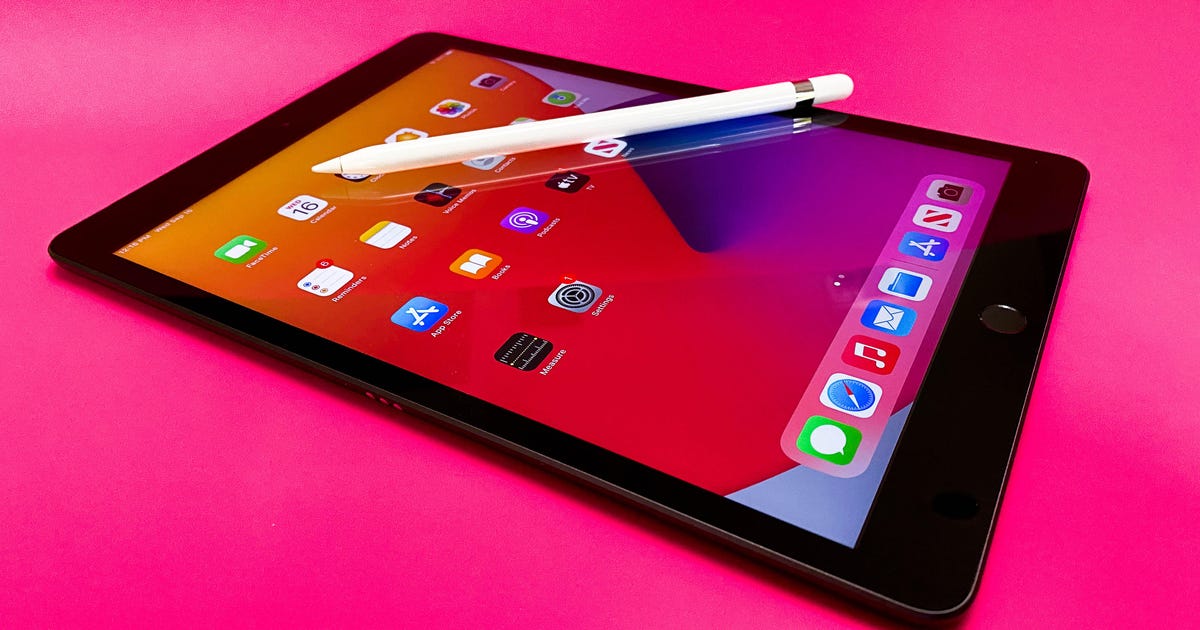
The basic iPad has been the "good enough" iPad for forever, while the Pro and Air have offered fancier features and better performance. This year, the iPad Air is getting a major revamp with a new processor, big display and USB-C, making it look much like an iPad Pro for less. But that new iPad Air starts at $599 (£579, AU$899). The new eighth-gen iPad I've been using, in the meantime, starts at $329 (£329, AU$499). Most stores will probably drop that to $300, and holiday sales could even bring it down further, if past years are any indication.
So what about this new 2020 entry-level iPad? It's an iPad, just like the one before. But it's a bit faster now. Whether you get one is basically the same question as before.
There's not a lot to say about this new 10.2-inch iPad. It's the same device as last year with one key improvement: Now it has an A12 processor instead of last year's A10. That's a big difference, and makes this a great time to consider the upgrade if you have an iPad that's several years old. Last year's basic iPad increased screen size and added a smart connector on the side, but it didn't change the processor. Upgrading is a major overhaul.
But you should also know that this basic iPad is a lot like last year's 2019 iPad Air and iPad Mini. So much so that, really, they're variants on the same device. (That 2019 Air is gone from Apple's website, but the Mini remains.) Think of it as last year's Air for less, and it's a good deal. But it's also an older iPad design. It still has a Touch ID home button and a headphone jack. And it still uses Lightning to charge and connect accessories, even though the upcoming iPad Air and current Pros use USB-C.
Here are the key similarities and differences between this new iPad and last year's Air and Mini:
The new eighth-gen iPad has the same processor and RAM as those iPads.
It also comes with less base storage (32GB).
The front-facing camera is worse on the eighth-gen iPad: 1.2 megapixels and 720p, versus 7 megapixels and 1080p on last year's Air and Mini.
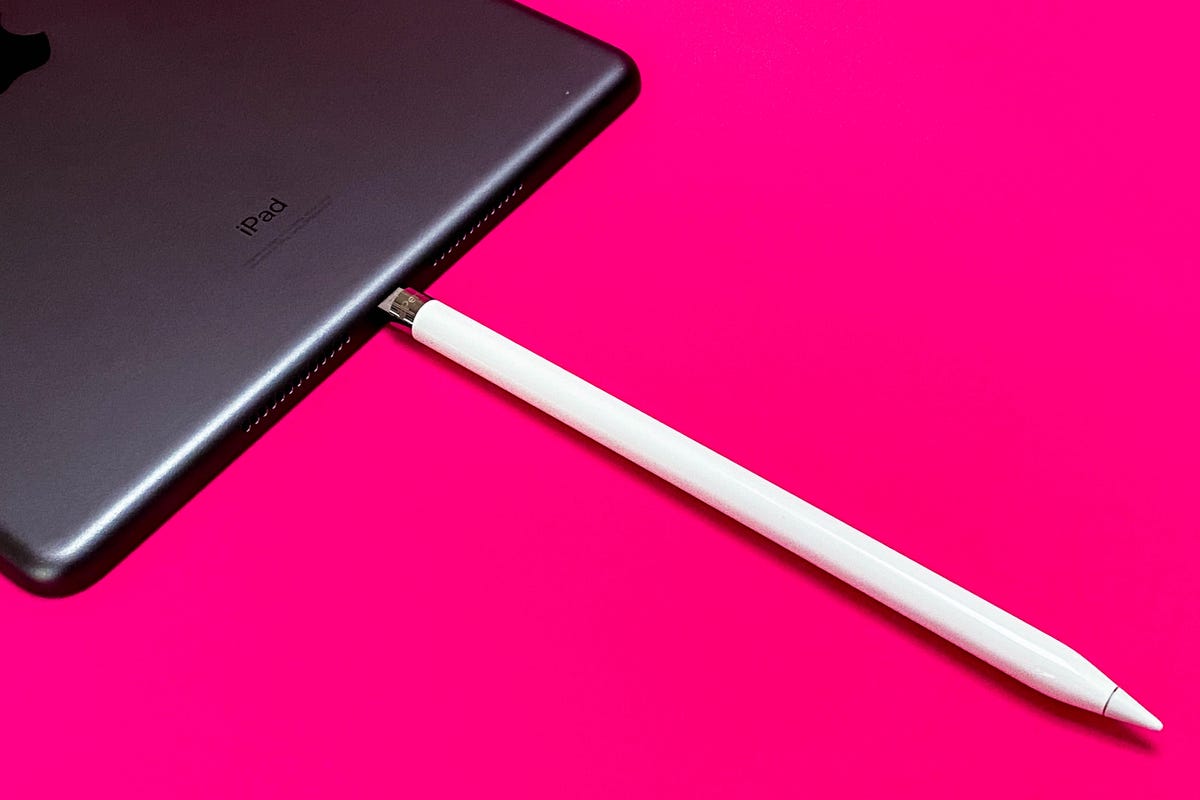
The eighth-gen iPad works with the first-gen Pencil, just like those older iPads. That means you'll have to stick it in your iPad's Lightning port to charge -- and lose track of the little pop-off Pencil cap on the end in the process.
It works with the same Apple Smart Keyboard as the 2019 iPad Air, but that's not true of every Air case. Logitech's Combo Touch, for instance, has the same keyboard base but has two models to fit the Air and iPad's different thicknesses.
The included charger is better and faster: It's 20 watts, and the cable is now Lightning-to-USB-C, allowing it to work better with recent MacBooks.
The 10.2-inch display is a bit smaller and a hair less vivid than the 2019 Air. But it's still more than good enough.
Now that the iPad supports trackpads and mice, it's also more versatile for web apps and tools.
A Lightning charger, still, but a faster 20-watt one.
Scott Stein/CNET
So this all adds up to: The iPad Is Totally Fine. More than fine, I'd say. I'm writing this review on it using the smart keyboard (editing and prepping on CNET's content management system is still best on a laptop).
The iPad still isn't as useful as a Chromebook for a lot of school tools, at least in my house. App support is amazing, and Apple's streaming-friendly ecosystem also helps it double as a fantastic little TV. But multitasking and file saving are still weird and frustrating, even with iPadOS 14 improvements.
iPads in my house tend to be free screens we grab to do things, and this basic iPad fits that role fantastically.
Do you wait for the 2020 iPad Air?
The fancier Air comes out soon, and it looks nice. It's also nearly twice the price. As a result, it's not the same product at all. The Air looks like it would make a lovely gift for someone who needs a more powerful iPad for art or graphics work, and wants to save over the Pro. But for most people I bet this iPad will be fine.
Why is the camera on the side?
Most annoying iPad feature in 2020: The front-facing camera is still on the side in landscape mode, which is the mode most of us do chats and Zooms in. My face ends up off-angle and strangely centered, staring off into space. The iPad's camera is good enough, even in a step-down mode, and better than most laptops. But it's terrible for centering your face. And everything now is Zoom.
The Apple Pencil still goes in the Lightning port to charge.
Scott Stein/CNET
No great keyboard cases?
The Logitech Combo Touch has a trackpad, but its bulkier case and kickstand design aren't great for lap typing. It's perfectly usable, but at $150 it's an expensive accessory.
There's no Apple Magic Keyboard for this iPad, but you can use Apple's older smart connector Smart Keyboard cover, which is compact but lacks a trackpad.
Trackpad and mouse support is the best 2020 iPad feature
Just like every other recent iPad, with iPadOS 14 you can connect a mouse or trackpad (or get a trackpad-enabled keyboard case). I find it a huge help with editing and navigating, especially while the iPad is propped up on a desk with a kickstand case.
The smart keyboard case and Apple Pencil work with this iPad, but they cost extra and aren't the most recent versions.
Scott Stein/CNET
Battery life so far: Pretty good, as always
I was able to do a Zoom for an hour without making much of a dent on a full charge. I multitasked, read, watched shows, played games, worked on stories, and the battery held. No surprise, since the iPad's claim of around 10 hours of battery life has been the same for years, though it varies a few hours more or less depending on the model. I haven't done a battery benchmark but it's doing a full day with ease. The included faster charger is welcome.
iPadOS 14 is here now, and you might want to eventually try it on your existing iPad first before upgrading iPads.
Scott Stein/CNET
What I miss most from better iPads
Compared to the higher-end iPads, this one lacks the extra screen real estate on its sides. This larger-bezeled iPad is fine, but in multitasking modes with two apps open it starts to feel cramped. The next iPad Air (or iPad Pros) feel considerably more expansive, even if it's just an inch or so. Most laptops, TVs and other screened devices make a big deal about how narrow their screen bezels are. Still, this only really matters if you need to multitask -- keeping Slack and Gmail on screen at once, for example, or writing while following news feeds. It can be done on this iPad, but it works better with a second screen that's narrower (like an email, Twitter or Slack stream).
I also miss the TrueTone on the 2019 iPad Air and iPad Pro (and iPhone). It auto-adjusts color temperature, and I've really gotten used to it. This iPad's display seems harsher or bluer than I'm used to. It also lacks the fancy 120Hz refresh of the iPad Pro, but you might not notice the difference. The 2,160x1,620-pixel display is otherwise great.
If you're looking for an iPad and have no idea which to get, this is the safe iPad bet and the one you should probably buy. It officially starts at $329, but many stores sell it for $299, which can drop to $250 during sales. And, yeah, I'd recommend going to the $429 128GB model for that extra storage security blanket if you're considering downloading more than a handful of apps. If you're a pro, and need pro-level features, then you're already considering the iPad Pro or the upcoming improved iPad Air. For everyone else -- families, students, anyone looking to pick up a good versatile extra screen -- this is where you're likely to start looking, and also where you're likely to end up.
Best trade in deal for iphone best mobile phone trade in best phone trade in best cell phone trade in best buy cell phone trade in program best cell phone deals best cell phones 2021
Best Cell Phone Trade-In Options for iPhones and Android Phones
Best Cell Phone Trade-In Options for iPhones and Android Phones
With smartphone technology advancing at a lightning pace, it can be downright irresistible to snag the latest models, even if you already have a great device in your pocket. You might want more storage, a better camera, or you might just want the latest color. It may even be that your other personal needs have changed between the time you originally got your smartphone and now. Whatever your reasons for wanting to upgrade, you'll most likely want to get the best phone trade-in you can for your current model.
Furthermore, with the pandemic squeezing pocketbooks, there's a rising demand to get your money's worth out of a mobile trade-in. That's where the CNET directory of gadget trade-in providers comes in. We'll look at a few of the best phone trade-in options like ItsWorthMore and others where you can get top dollar for your devices.
Read more: Best Places to Sell Your Used Electronics in 2022
To evaluate the merchants on our list, we looked at a composite picture of each business. We ranked merchants based on our research into Better Business Bureau ratings, CNET staff reviews, online reputation among resellers and how easy or hard it is to get in touch with someone at each business, among other factors.
Every service is different, though, and trade-in values change by the day. They also assign values based on the condition of the cell phone you're trading in, and take into account things like the device's color. This means that preowned phones in good condition are likely worth more money or store credit.
So you're going to have to shop around. Below the list of merchants is our basic FAQ of carriers, buyers and online marketplaces for your best phone trade-in experience.
Smartphones: Yes
Tablets: Yes
Laptops: Yes
iPods: Yes
Action cameras: Yes
Wearables: Yes
Other: Kindles, books, video, more
Not surprisingly for the king of online commerce, Amazon offers trade-in pricing for a large number of items, including phones and tablets, as well as books and videos. Because Amazon also has its own marketplace, you can also choose to list pretty much anything and expect to have a chance to sell it through Amazon.
We focused specifically on the Amazon Trade-in offering only. If you're not a regular Amazon customer, you might be disappointed to find that Amazon only pays in Amazon Gift Cards. For those of us who are dedicated Prime users, that's pretty much the same as cash, but you need to decide.
There's long been a rumor that Prime customers get better trade-in prices than non-Prime customers, but when we asked Amazon, we were told that everyone was treated equally.
In terms of the mechanics of the trade-in, Amazon will send you a prepaid shipping label you can print out. Pack the device yourself in your own packaging (like an old Amazon box) and send it back. You should clear your phone of data, but Amazon will also do that for you. Make sure you don't dawdle when shipping your item. The quote time is valid only for seven days, and you should get paid in about 10 business days.
Angela Lang/CNET
Smartphones: Yes
Tablets: Yes
Apple offers two ways to trade in your iPhones and iPads. You can either walk into an Apple Store or use an online service run by Apple partner Phobio.
Either way, don't expect to trade in your iPhone and get money you can use to go out and buy that hot new Google Pixel 4 phone. Apple's trade-in services only give you Apple Gift Cards. If you're staying in the Apple ecosystem, this might work for you. If you're jumping ship or just need the money, you'll need to look to another alternative.
I liked the convenience of a walk-in trade-in, assuming you're near an Apple Store. If you go the online route, quote time is valid only for 14 days, and you should get paid quite quickly, with the company promising two business days in most cases.
Like Amazon, going with Apple is a bit of a no-brainer, but only if you're OK with its limits: iPads and iPhones only, exchanged for Apple Gift Cards only.
Gadget Gone
Smartphones: iPhones only
Other: Contact merchant directly
If you want to sell your iPhone (and only your iPhone) to a company with a fun tag line, GadgetGone is for you. The site has "Goodbye iPhone. Hello Moola" plastered on the front page, just in case you didn't understand what it does. It claims to take items other than iPhones, but its online estimator only works for iPhones. You have to email to find out what else it's interested in.
The company pays by check and PayPal, but also will pay you using a "printable echeck." While printable checks are a pretty standard practice for some businesses, you probably should ask your bank whether they'll accept a check printed out on your inkjet.
I like the company's "two days to payment" policy, but GadgetGone stumbles on its lack of security practices and price offer guarantees. It also provides no clear method for phone support, and offers almost no background on the company itself on its website.
igotoffer
Smartphones: Yes
Tablets: Yes
Laptops: Yes
Wearables: Yes
Other: Macs
If you dig deep in its menu system, you will find Samsung and Google phones listed for trade-in at igotoffer, but this is mostly an Apple-branded trade-in shop. Not only does it make offers on Apple phones, but also on Mac Pros, Apple Displays and Apple TVs.
That said, igotoffer doesn't let you know how long its offer quote is good for, and it doesn't specify whether it provides a security wipe on your data (you should do it anyway). There also appears to be no telephone support.
If you do want to trade in your iPhone, the company will email you a prepaid shipping label you can print out. That's workable, but I prefer the full shipping kit with a box designed to protect your device. igotoffer says it pays within three business days by check, PayPal or Amazon Gift Card.
It'sworthmore
Smartphones: Yes
Tablets: Yes
Laptops: Yes
iPods: Yes
Wearables: Yes
Desktops: Yes
Most of what It'sWorthMore accepts are Apple products, but the company also lists Android devices and some other laptops and tablets.
The company provides a 14-day offer quote guarantee and a prepaid shipping label, and it pledges to pay within three business days. It also provides phone support.
It'sWorthMore pays by check and PayPal, but here's a kicker. If you ask for payment via PayPal, the company deducts 3% to cover its PayPal fees. It's a little too nickel-and-dime for our tastes and makes us wonder whether it'll be generous in its final payment determinations, or if it will be just a little too cheap. If you use this service, let us know how it did from quote to final payment in the comments below.
Decluttr
Smartphones: Yes
Tablets: Yes
Laptops: Yes
Wearables: Yes
Other: Media, Lego, Games
If you want to get money for your clutter, Deculttr Is the place to bring your stuff. They take in many different smartphone models, some tablets, some Kindle models, game consoles and games, DVDs, CDs, Blu-rays and Lego products (Hey, don't knock the Lego. That stuff has a pretty high resale value, especially with full sets).
Although they don't provide a shipping kit, we liked how they suggested filling a box (they say any box will do) with up to 200 items and send it into decluttr.com. It's a great way to clear out a pile of gear and get some money back.
Plus, you can trade-in your device an earn an extra 10% of trade-in value (maximum $40) code CNET10EXTRA.
We don't like that the company doesn't clearly specify how long their price quotes are good for, and that it doesn't explicitly state that it wipes your technology on receipt. Instead, they have some FAQ entries about how you can do that yourself.
That said, the company does offer solid phone support and a great way to check the value of products before shipping, and free insurance on items you ship to them.
What about Gazelle?
Gazelle has lived on this list for a long time, but after refining our review criteria, we've removed it. The change comes in light of an increased number of poor customer reviews and recent complaints to the BBB. We will continue to update this list over time.
FAQ: Carriers, buyers and online marketplaces
When looking for value from your old phone, there are four types of organizations you can work with: retailers, buyers, marketplaces and carriers. The characteristics of each are quite different:
Retailers: These are the brick-and-mortar stores in your neighborhood, ranging from Walmart and Target all the way to the remaining Radio Shack locations. In many cases, you can walk into the retailer, hand over your old Apple, Google or android phone and walk out with a new one, with a healthy discount applied. Many of these retailers won't just give you money for your old phone. They want the deal for your new business and give you a trade-in offer, so keep that in mind. Some also offer online trade-ins.
Carriers: These are the cellular service providers and almost all of them have some sort of mobile phone trade-in program, to encourage you to trade up to the next model and keep their service. Good news: this doesn't necessarily mean that the phone needs to be in working condition.
Buyers: These folks want your phones and will give you money or credit for them. A buyer generally won't force you to buy a new device from them (although expect some deal sweeteners if you go that way). Some of them will send you packaging to send your device back to them. This is the group we look at in this guide because they generally send you real money in return for your device, which means you're free to buy anything you want once you get your green.
Marketplaces: This option includes the classic resell methods like Craigslist and eBay, along with some specialty referral marketplaces like Flipsy, which are built around the idea of trading in gadgets. Here, you're often dealing directly with individual buyers (or bulk buyers who are scooping up phones for other markets). Straight talk, though: There is substantially more risk when selling to individuals than companies with known reputations.
Keep those concepts in mind as you look for the best deal for your device.
Apple, Google, Other Tech Giants Urge Texas to Drop Anti-Transgender Legislation
Apple, Google, Other Tech Giants Urge Texas to Drop Anti-Transgender Legislation
More than 60 companies, including tech giants Apple, Google, Microsoft, Meta and Salesforce, signed an open letter calling for Texas Gov. Greg Abbott and other lawmakers to abandon an order that equates gender-affirming medical care for transgender children to child abuse.
The letter, published in a full page ad in the Dallas Morning News on Friday, calls for an end to "efforts to write discrimination into law and policy." It was organized in partnership with LGBTQ+ civil rights group Human Rights Campaign.
"The recent attempt to criminalize a parent for helping their transgender child access medically necessary, age-appropriate healthcare in the state of Texas goes against the values of our companies," reads the open letter. "This policy creates fear for employees and their families, especially those with transgender children, who might now be faced with choosing to provide the best possible medical care for their children but risk having those children removed by child protective services for doing so."
See Also:In Texas, Big Tech's Liberal Leanings Take a Back Seat
In February, Abbott directed state agencies to investigate claims of children receiving gender-affirming medical care. The order also requires medical professionals and teachers to report children receiving care or face "criminal penalties."
The move drew swift backlash from civil rights groups and medical organizations. The American Medical Association supports "patient-led" gender-affirming care and has said attempts by states to prohibit care for minors patients are "inappropriate and harmful."
Apple CEO Tim Cook also spoke out about the issue in a tweet on Thursday. "As a proud member of the LGBTQ+ community, I am deeply concerned about laws being enacted across the country, particularly those focused on our vulnerable youth," Cook wrote. "I stand with them and the families, loved ones, and allies who support them."
Other companies that signed the letter include Box, Capital One, Cisco, Corning, Dropbox, Electronic Arts, Gearbox, IBM, Ikea, Johnson & Johnson, Patreon, PayPal, Pinterest, Shutterstock, SXSW, Unilever, VMWare, Yahoo and Yelp.
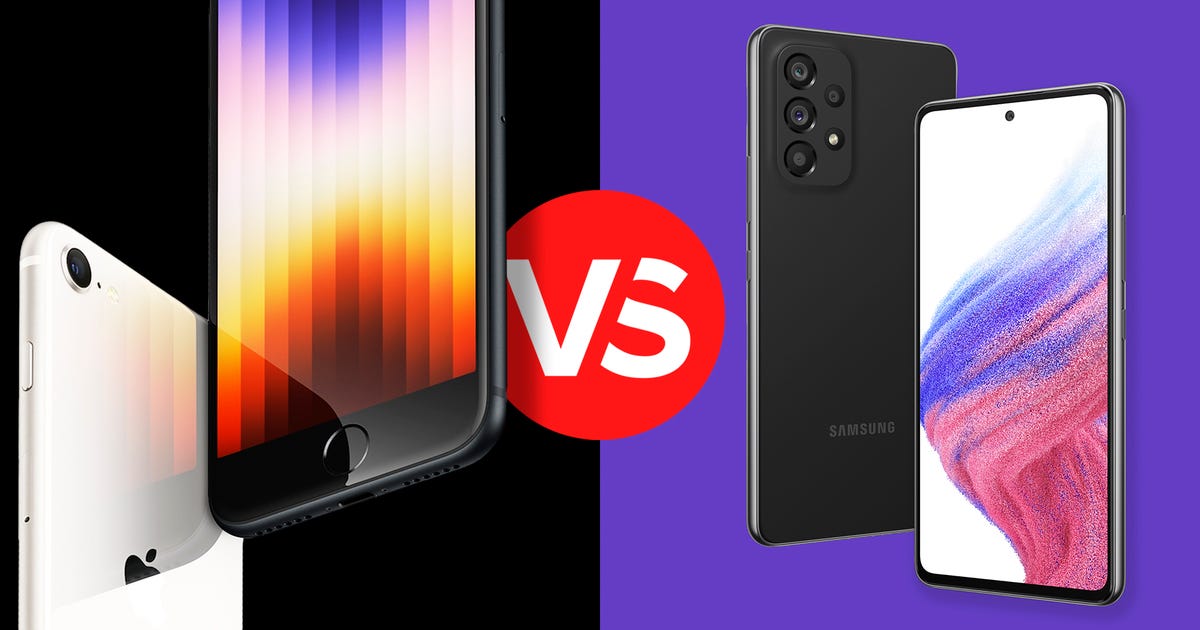
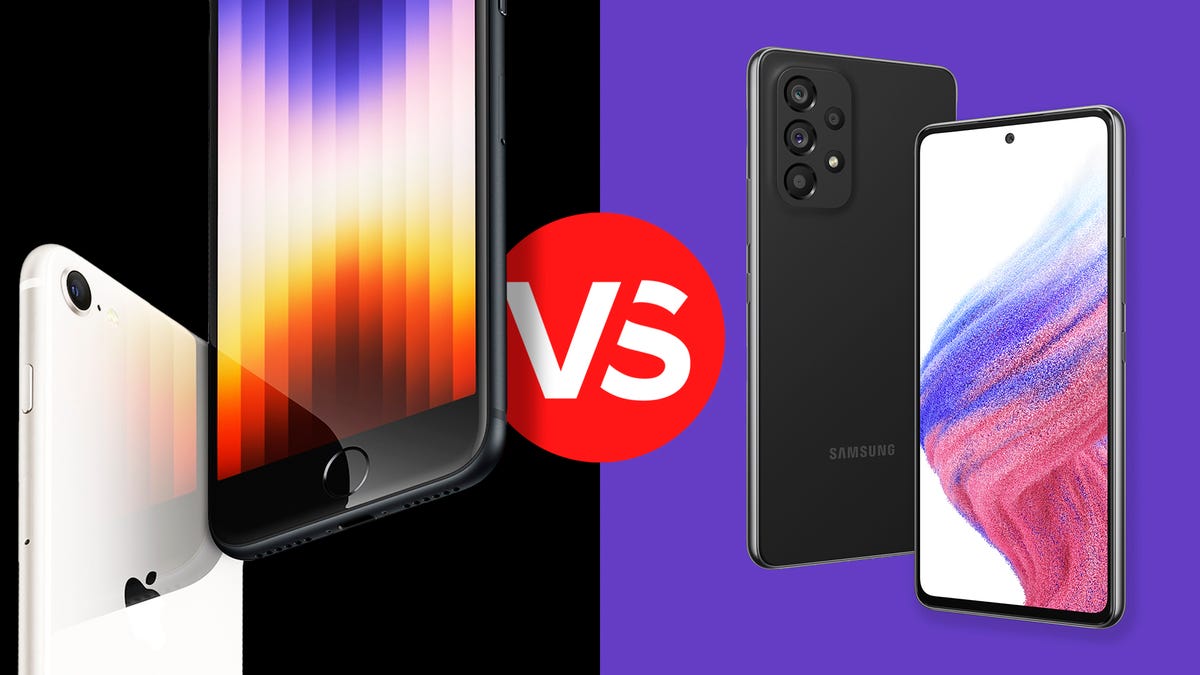
iPhone SE vs. Galaxy A53 5G: Plenty of Value, Different Approaches
iPhone SE vs. Galaxy A53 5G: Plenty of Value, Different Approaches
Apple's $429 iPhone SE and Samsung's $450 Galaxy A53 5G both launched last month as more affordable alternatives to the Galaxy S22 and iPhone 13. Although both feature 5G connectivity and a similar price, they have little else in common, as the companies take opposite paths to cheaper phones. Samsung's A53 brings higher-end features like a multilens camera and a display with a high refresh rate to a more affordable device. The iPhone SE, on the other hand, has an old-fashioned design packed with Apple's latest mobile processor.
Which one is right for you will largely depend on whether you prefer Android or iOS. But these devices also illustrate how differently Apple and Samsung approach the market for lower-priced phones. Samsung cares about imitating its high-end phones, while Apple prioritizes performance and drawing customers into its ecosystem of services and accessories.
Here's a closer look at how the two phones compare.
Samsung goes for a modern design; Apple sticks with its classic build
The Galaxy A53 5G
Lisa Eadicicco/CNET
Appearance is perhaps the biggest difference between the Galaxy A53 and the iPhone SE. The Galaxy A53 could easily be mistaken for other Samsung devices such as last year's Galaxy A52 5G and the Galaxy S21 FE. Like those phones, the A53 has a nearly borderless screen with a hole punch-shaped cutout for the front camera. The back of the device has a matte finish with a rectangular module for the device's camera. Samsung is clearly trying to replicate the general look and feel of its Galaxy S phones on the Galaxy A53, but with some compromises. For example, the Galaxy A53 has a plastic construction that doesn't feel as luxe as the glass build found on the iPhone SE and Samsung's more expensive Galaxy S22.
The iPhone SE has a retro look that's distinctly different from the iPhone 13 and Apple's other recent phones. It essentially has the body of an iPhone 8 packed with the guts of an iPhone 13. That means it has the same thick bezels above and below the display as Apple's older iPhones, along with its Touch ID home button. It's the only iPhone Apple still sells that has the home button, which might make it the right choice for those upgrading from an older phone. But the iPhone SE's classic design and lower price also means it's missing Face ID. The Galaxy A53, by comparison, has a fingerprint sensor built into its display and also supports facial recognition for unlocking the devices. (However, Samsung cautions its facial recognition feature is considered less secure than other lock types).
The 2022 iPhone SE
Chris Parker/CNET
More importantly, both phones also have drastically different screen sizes. The Galaxy A53 has a 6.5-inch screen that makes it around the same size as the Galaxy S21 FE and Galaxy S22 Plus. Samsung's phone can also boost its refresh rate up to 120Hz for smoother scrolling, a feature Apple only offers on the pricier iPhone 13 Pro and Pro Max.
The iPhone SE's 4.7-inch screen is essentially the same as the one on Apple's 2017-era iPhone 8, making it the smallest Phone Apple currently sells in terms of display size. It's ideal for those who prefer smaller-sized phones and are upgrading from an aging device like the iPhone 8 or iPhone 7. But it'll certainly feel like a dramatic shift from phones like the iPhone X or iPhone XS, both of which have larger 5.8-inch screens.
Samsung's camera has multiple lenses, but Apple's still has good image quality
The Galaxy A53's camera has more lenses and a main sensor with a higher resolution than the iPhone SE. But Apple's camera still performs well for the price. The Galaxy A53 technically has four lenses: a 64-megapixel main lens, 12-megapixel ultrawide lens, 5-megapixel macro lens and 5-megapixel depth lens, although it's really the main and ultrawide lens that matter most. The iPhone SE, on the other hand, only has one 12-megapixel main lens.
Samsung's phone offers more flexibility since it has dedicated shooting modes for ultrawide, macro and night shots. If you often find yourself taking crowded family photos or sweeping landscape shots, you'll benefit from the Galaxy A53' wider field of view. The same advice applies if you frequently take photos in dim environments, such as a candlelit bar or music venue, since the iPhone SE lacks night mode.
Galaxy A53 5G
A photo taken with the Galaxy A53's ultrawide camera.
Lisa Eadicicco/CNET
iPhone SE
The iPhone SE lacks an ultrawide camera.
Lisa Eadicicco/CNET
Galaxy A53 5G
This was taken on the Galaxy A53 using night mode.
Lisa Eadicicco/CNET
iPhone SE
This photo was taken on the iPhone SE, which doesn't have night mode.
Lisa Eadicicco/CNET
But the iPhone SE's single-lens camera also takes great photos that are colorful and sharp enough for casual users. There were even a couple of scenarios in which I preferred the iPhone SE's photo over the Galaxy A53's, such as the photo of my cat below, although it was generally a close call between the two.
Galaxy A53 5G
This photo was taken on the Samsung Galaxy A53.
Lisa Eadicicco/CNET
iPhone SE
A photo taken on the iPhone SE.
Lisa Eadicicco/CNET
Image quality can also depend on your preference. Some might prefer the bolder color in the iPhone SE's image below, while others might find Samsung's to be more natural.
Galaxy A53 5G
A photo taken with the Galaxy A53 5G.
Lisa Eadicicco/CNET
iPhone SE
A photo taken with the iPhone SE.
Lisa Eadicicco/CNET
The Galaxy A53 also takes better selfies with brighter lighting than the iPhone SE in my experience, considering it has a 32-megapixel selfie camera compared to Apple's 7-megapixel front camera.
Take a look at the difference below.
Galaxy A53 5G
A photo taken with the Galaxy A53 5G's selfie camera.
Lisa Eadicicco/CNET
iPhone SE
A photo taken with the iPhone SE's selfie camera.
Lisa Eadicicco/CNET
All told, you're getting more for your money with the Galaxy A53. But the iPhone SE takes solid photos even though its camera is more limited. And Apple's phone can record in 4K at up to 60 frames per second, whereas the Galaxy A53 only supports 4K video capture up to 30fps.
Apple wins at performance, but Samsung has other extra perks
The iPhone SE may be tiny, but it has the same powerful A15 Bionic processor as the iPhone 13. The Galaxy A53, meanwhile, runs on Samsung's Exynos 1280 instead of the faster processor found in the Galaxy S22 series.
You probably won't notice the difference most of the time. The Galaxy A53's 120Hz refresh rate also makes scrolling around the phone's home screens and settings menus feel fluid. But there are moments when the Galaxy A53's less powerful processor shows. There were instances in which the Galaxy A53's keyboard wouldn't show up as quickly as it should, for example. Sometimes I also had to press the home button multiple times to quit an app. It's not disruptive enough to discourage me from recommending the phone, but it was occasionally noticeable.
That's one area where the iPhone SE really shines. Since it has the same processor as Apple's top-of-the-line iPhones, it performs just like a flagship phone. In his review of the iPhone SE, my colleague Patrick Holland said, "the SE flies and iOS animations look smooth." My own experience with the iPhone SE has been similar. Apps launch quickly, the keyboard pops up instantly and search results for local apps stored on the phone appear right away.
Benchmark tests told a similar story. The iPhone SE scored much higher on tests meant to evaluate general processor and graphics performance compared to the Galaxy A53.
Geekbench 5 Single Core
Note:
Higher scores are better.
Geekbench 5 Multicore
Samsung Galaxy A53 5G
Note:
Higher scores are better.
3DMark Wild Life Extreme
Note:
Higher scores are better.
Both phones can provide all-day battery life, although longevity will always vary depending on how you use your device. I'm typically able to get about a day and a half out of the Galaxy A53 before plugging it in, even with the refresh rate set to high. The iPhone SE, which has a lower refresh rate than the Galaxy A53, usually had between 20% and 30% of battery left at the end of the day, according to CNET's review. But unlike the Galaxy A53, the iPhone SE supports wireless charging. That's not a deal-breaker, but it might be something to consider if you already have a charging pad.
Yet Samsung's phone has a couple of other extras you won't find on the iPhone SE, such as 128GB of internal storage on the cheapest model, a microSD card slot for adding up to 1TB of extra space and support for both millimeter wave and sub-6 Ghz 5G. The iPhone SE starts with half the storage (64GB) and lacks a microSD card slot, meaning you'll have to buy the $479 version to get 128GB of space. It also isn't compatible with millimeter wave 5G, although that might not matter much since that faster variant of 5G isn't widely available and only operates at short distances.
Both phones are rated for IP67 water resistance, which means they can endure being submerged in one meter of water for up to 30 minutes.
You also shouldn't have to worry about either phone feeling outdated anytime soon when it comes to software support. The Galaxy A53 is guaranteed to get four generations of Android operating system updates and five years of security updates. Apple's iOS 15 software works on phones as old as the iPhone 6S from 2015, so it seems safe to say the new iPhone SE has a long road ahead of it.
The bottom line
The iPhone SE (left) and Galaxy A53 5G (right)
Amy Kim/CNET
The Galaxy A53 and iPhone SE both provide plenty of value for the price, but in different ways. With long battery life, a large display, an in-screen fingerprint sensor and multiple cameras, the Galaxy A53 feels like a light version of Samsung's pricier Galaxy S phones. Just remember: You may have to deal with occasional lag.
The iPhone SE, on the other hand, has a retro design that makes it a strong choice for those who may be upgrading from an older iPhone. It doesn't have modern features like a multilens camera or a large, borderless screen, but it's as fast as the iPhone 13 and 13 Pro thanks to Apple's A15 Bionic processor.
But perhaps most importantly, it's the cheapest way into Apple's services and accessories. That might make it appealing to longtime iPhone users that don't want to spend $500 or more on a new phone, but also aren't willing to abandon their AirPods or switch to Android.
5G-enabled; Water resistant (IP67); dual-SIM capabilities (nano-SIM and e-SIM); wireless charging
Price off-contract (USD)
$450
$429 (64GB), $479 (128GB), $579 (256GB)
Price (GBP)
£399
£419 (64GB), £469 (128GB), £569 (256GB)
Price (AUD)
AU$699
AU$749 (64GB), AU$829 (128GB), AU$999 (256GB)
Lisa Eadicicco/CNET
New for 2022, the Galaxy A53 gets you an abundance of Samsung features and power at a fraction of the S-series price. It boasts a far larger screen and more versatile camera cluster than the iPhone SE, though Apple's budget model delivers snappier performance.
Still, Samsung fans will appreciate what they're getting here considering the affordable price. The Galaxy A53 5G has an ultrawide lens for taking photos with a broader field of view and also supports night-mode photography. Image quality isn't as good as what you'd get on a more expensive Samsung phone like the Galaxy S21 FE or Galaxy S22, but it's certainly clear and colorful enough for basic shots. Other highlights include a long-lasting battery, four guaranteed generations of Android operating system updates and a microSD card slot for expandable storage.
Overall, the Galaxy A53 5G is a suitable choice for those who prioritize having a large screen and long battery life for less than $500. Just keep in mind, you might have to deal with some occasional lag, and the camera isn't as advanced as those found on pricier phones. Read our Samsung Galaxy A53 5G review.
Patrick Holland/CNET
The long-awaited successor to the iPhone SE (2020) was announced by Apple during its March 8 "Peek Performance" event. It features Apple's A15 chip (which is the same one found in the iPhone 13 series), 5G and stronger glass, but the same overall design as the previous generation.
Pricing for the new iPhone SE starts at $429 and is available now.