Here is one of the pictures featuring the Third Party Apps Google. Numerous images associated with the Third Party Apps Google can be utilized as your point of reference. Below, you'll find some additional pictures related to the Third Party Apps Google.
One-Third of Apple and Google Apps Are So Outdated They Could Get Removed
One-Third of Apple and Google Apps Are So Outdated They Could Get Removed
A new report finds that 1.5 million apps on both Apple's App Store and Google's Play Store haven't been updated in two years or longer and get hidden or removed entirely according to recent policy changes.
These "abandoned" apps constitute one-third of the combined app catalogs of the App Store and Play Store, according to the report from analyst firm Pixalate. Google's store had around 869,000 apps that had been neglected for more than two years, while Apple's store had around 650,000. After two years without an update, apps are more vulnerable to exploits, which is why Apple and Google have introduced new policies in recent months that punish apps neglected by their developers.
If an app hasn't been updated in two years, it will be hidden from view on the Google Play Store and won't appear in search results. Apple's policy for outdated apps is far less clear, though at least one developer said their app would be removed because it was more than two years old.
Plenty of apps are more up to date, per the report, with 68% of apps on both stores, or over 3.1 million apps, updated within the last two years. Apps that updated more frequently tended to be those with far more downloads: 84% of the apps with over 100 million downloads had been updated in the last six months.
Neither Apple nor Google responded to comment by time of publication.
Xiaomi, accused of tracking 'private' phone use, defends data practices
Xiaomi, accused of tracking 'private' phone use, defends data practices
Xiaomi is defending itself against accusations that it's been collecting private data from people who use its phones and web browser apps. This follows a report Thursday from Forbes that raised concerns the Chinese phone maker is collecting private data on the websites users visit as well as granular information about apps used and files opened on devices.
In a blog post Friday, Xiaomi laid out some of its data practices, saying it collects aggregated usage statistics on things like responsiveness and performance that can't be used to identify individuals. The company also said it syncs web browsing history if people have the feature turned on in their settings. It denied any wrongdoing and said Forbes misunderstood its data privacy principles and policy.
"At Xiaomi, our users' privacy and security are of top priority," the company said in its post. "We strictly follow and are fully compliant with user privacy protection laws and regulations around the world."
On Thursday, Forbes cited multiple security researchers who said the company was collecting web history as well as phone data such as "unique numbers for identifying the specific device and Android version" that could be connected to the person using the device. The combination of the data and the identifying numbers could let Xiaomi associate all the data it collects with individuals, which security researcher Gabi Cirlig told Forbes was the most concerning aspect of his findings.
Cirlig told the publication that when using the default Xiaomi browser on his Redmi Note 8, it "recorded all the sites he visited, including search engine queries" and "every item viewed on a news feed feature of the Xiaomi software." Cirlig said this tracking appeared to happen even when browsing in incognito or private mode, according to Forbes.
The phone also reportedly recorded things like folders that were opened and screen swipes. Cirlig told Forbes that the data was sent to remote servers hosted by Chinese tech giant Alibaba, which were rented by Xiaomi.
Other browsers, such as Chrome (made by Google) and Firefox (made by Mozilla), also collect aggregated user information about sites visited. However, these browser makers also offer detailed information about how the data is protected. Google says that Chrome collects "anonymous, randomized data" about usage that isn't associated with user identifiers. In 2017, Mozilla launched a program to collect usage data from Firefox users, protected with a process called differential privacy that makes it very difficult to see if a given individual's data is included.
Phones that run Apple's iOS or Google's Android operating systems come with their share of privacy concerns, and researchers often have to delve deep into the devices to see what kinds of location and app usage data third party apps are collecting and sending to advertisers. But this is different from the phone maker itself collecting user data, which Apple says it tries to limit as much as possible by processing user data on the phone and leaving it there.
Google also processes data on the phone when possible, and both companies have developed differential privacy methods for analyzing their aggregate data collections. In addition, Google has developed federated learning programs, which let computer programs analyze data with machine learning on users' devices. The insights from the data are removed from the phone, instead of the data itself.
In response to a question on whether it uses differential privacy or other protections on user data, Xiaomi said it has used the technology in a limited way for beta testers in China. "We have plans to expand the technology further to our products and users globally," the company said in its statement, "and will continue to improve and implement even more stringent privacy measures to ensure the internet security of our users."
How to Stop Strangers From Accessing Your Spotify Account
How to Stop Strangers From Accessing Your Spotify Account
Music streaming has become essential in helping listeners discover artists, access new releases or turn into homegrown DJs. As an avid Spotify user, I hold my account – and my playlists – dear. Many of you probably have playlists for the gym, meditation, road trips, household chores, parties or the ride to the grocery store. Or perhaps you have a favorite podcast, or have even mastered all the cool tricks on the music streaming service. And at the end of the year when Spotify sends out your personalized Wrapped roundup, you may even feel a frisson of excitement.
Now imagine someone hacking into your Spotify account, rearranging your library, creating new playlists or locking you out by changing the password. It's so much more than just a minor annoyance! In some cases you may not have even been hacked, but simply left your account logged in by accident. In any case, if you suspect a stranger has infiltrated your account, here's how to handle it.
Look out for these warning signs
The most obvious sign that someone is using your account is the inability to log in to Spotify. If your password and/or email suddenly don't work, count that as a double red flag. While you should ordinarily be able to request a new password (and then change it as below), it's possible that a freeloader has stolen your original login details. In that case, you won't be able to update the password or email address on your own and you will need to contact Spotify. Sadly, the company does not offer two-factor authentication, so the onus is on you to monitor your credentials.
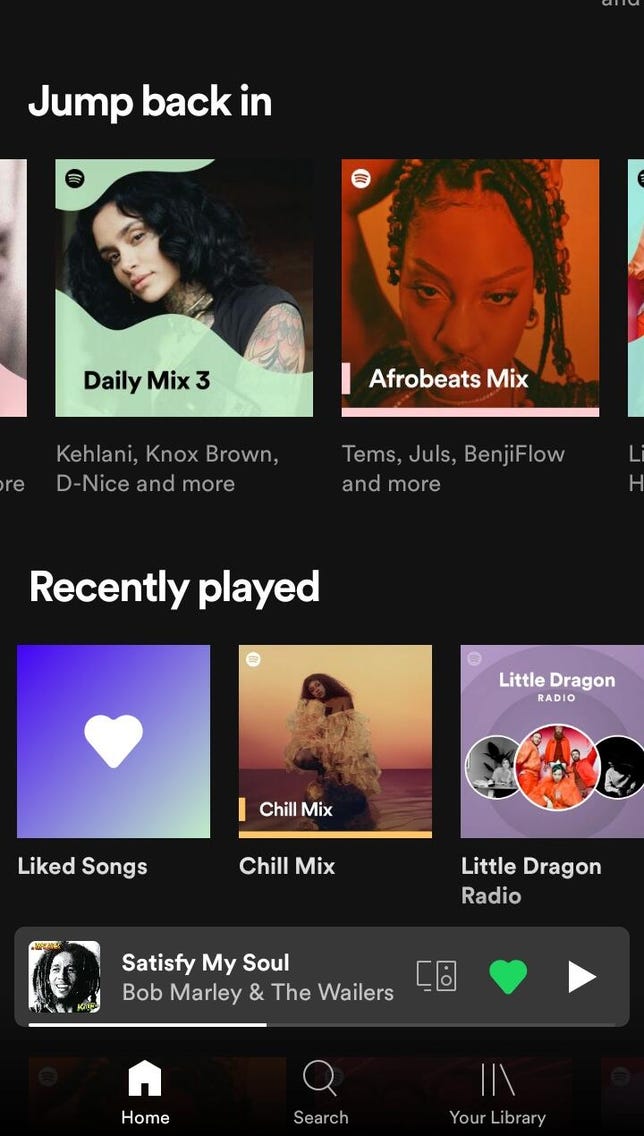
Otherwise, if you still have access to your account, the other user may have been more subtle, and so there are other things you should check. For instance, click on your "Recently played" row and see if it is out of whack. The same goes for the "Jump back in" section where you may find songs or mixes that arouse suspicion. Another obvious clue that your account has been accessed without your knowledge is the addition or removal of playlists. If you see something that you or Spotify didn't curate and there are songs nowhere near what you'd normally listen to, an outsider may have gained access.
Scroll through the "Jump back in" and "Recently played" sections on your main screen.
Screenshot by Kourtnee Jackson/CNET
According to Spotify's help center, other indicators that a stranger may have taken over your account include changes to your subscription plan, music playing randomly without your control and email alerts about weird login credentials.
Presuming you have access, scan your account details under Settings to review your email address and plan type. Make sure both are accurate. Often, data breaches on other sites lead to emails and passwords being collected by criminals. Though Spotify assures users that its service is secure, there's a possibility someone can nab your login credentials elsewhere. Take an extra step to see if your email's been comprised by visiting Have I Been Pwned. Type in your email to check whether it's been shared on the dark web.
Last, while occurrences of music automatically playing on its own could be attributed to third-party apps like Google's alarm clock or Samsung's Bixby routines, there's still a chance it means a stranger has access to your Spotify account. And if you have multiple devices or external accounts connected to Spotify, there are ways to stop random tunes from blaring through your speakers.
Close out Spotify and reset your password
The best way to put a stop to the takeover is by shutting Spotify down on all devices and changing your password. Spotify advises users to change their passwords in an incognito window when opening the reset password link. The company also suggests updating passwords for external services connected to your Spotify account, such as Facebook, Google and Apple.
Here's how to do it: On a web browser, log in and navigate to your Account page under your Profile. Scroll down and click "Sign Out Everywhere." This will log you out of Spotify on your phone, tablet, web player or the desktop version.
Be extra cautious and log off from your Spotify account on each device.
Screenshot by Kourtnee Jackson/CNET
However, if Spotify is linked to your TV, gaming console or speaker, you will have to sign out separately. From your desktop app, head to your Account overview page, locate the menu on the left side, and select Apps, which is denoted by a puzzle piece icon. You'll see a list of connected apps. You may see Facebook and other integrated apps like Tinder, Discord, Apple TV or Slack. Click Remove Access, which will block access and sign you out of Spotify.
Examine your bill
Spotify users who are set up for automatic payments may not always check their billing statements each month. Take a moment to scan your billing statement and look for any discrepancies in your plan type. Did you sign up for Premium Individual subscription but are suddenly paying for a Premium Family plan? If you notice that you're being charged for a subscription that you didn't select, contact Spotify.
Additionally, it's worth noting that Spotify accepts multiple payment methods, including debit/credit cards, PayPal, gift cards and pay as you go. You may be paying Spotify directly with an in-app method, but if you are billed through a third party such as an internet provider or mobile phone carrier, verify that your payment information is secure.
Contact Spotify if you've lost access or your playlists
You should reach out to Spotify in the event you get locked out of your own account due to someone changing the email address and password, or for escalated issues related to a possible hacked account. Customer support may assist with recovering lost playlists, compromised login credentials and billing errors.
Currently, Spotify doesn't have a way to contact its customer service team by phone. Instead, you can reach out using its chat feature, or by reaching out on Twitter: @SpotifyCares or the SpotifyCares Facebook page.
Free download of malwarebytes software malwarebytes free download windows 7 malwarebytes free malwarebytes free trial malwarebytes free mac malwarebytes free license key malwarebytes free version not trial malwarebytes free vs premium
Malwarebytes - Free download and software reviews Download
Malwarebytes - Free download and software reviews
Malwarebytes 3.0 was a major update when it arrived in December 2016 -- and like many major updates, some aspects were a little rough, particularly stability within Windows 10. With version 3.2, the company claims it has corrected some major issues, so let's take a look at how this revision stacks up.
Pros
It's stable in Windows 10: With version 3.0, some users (us included) experienced seemingly random blue-screen errors in Windows 10 unless we disabled most or all of Malwarebytes' active scanning functions. As a result, there wasn't a lot to distinguish the paid version from the free one. However, we can report that we didn't see any BSODs in Windows 10 during our testing of 3.2. This was the only truly major issue we saw in version 3.0, so addressing it brings Malwarebytes back up to "recommended" status.
The scanning engine remains high-quality: During our tests, the app's malware scanner picked up some files and a Registry entry left over from an apparently incomplete uninstallation of a third-party driver management utility that, according to Malwarebytes, may have bundled a potentially unwanted program (PUP). Malwarebytes defaulted to placing these files in quarantine rather than deleting them. This is actually the preferred reflex, since PUPs aren't necessarily harmful, and extracting them can disable the program that they came with. Generally speaking, Malwarebytes' scanning tech is rated favorably by independent testers, such as West Coast Labs and Google's VirusTotal service, and it's cultivated a reputation for not bogging down your PC.
Detailed, plain-English explanations: While other security vendors often slather on fancy-sounding terminology, Malwarebytes is good at telling you exactly what a given feature is doing. Take the "Usage and Threat Statistics" toggle, for example. This covers the anonymous usage data that it collects. In the description on its website, Malwarebytes itemizes basic things like, how many people are running the free version, trial version, and subscription versions? Where is Malwarebytes being used globally? What malware is being detected the most, and how often?
Its full privacy policy even includes detailed and simplified explanations side-by-side. This kind of transparency about your data -- and the deliberately limited extent of it -- is good to have, and it's not as common in the security industry as it should be.
Cons
Limited testing by independent labs: The company asserts that the average "zero day" malware (the kind that's too new for there to be reliable detection/removal) has only a 55 percent detection rate, which can make a given antimalware app look worse than it is when subjected to a barrage of zero-day infections during testing. Therefore, Malwarebytes does not submit its apps to the full gauntlets provided by AV-Test and AV-Comparatives, whose testing takes special notice of zero-day security. However, if Malwarebytes wants to be recognized among its competition, we'd argue that it needs to submit its apps to the same rigorous standards as the competition, even if those standards can create perception issues.
Bottom Line
Now that Malwarebytes appears to have fixed its stability issues in version 3.2, the user experience is rounded out nicely. However, we'd like to see Malwarebytes go through the gauntlets set up by AV-Comparatives and AV-Test to get a better picture of how it stacks up against the competition.