Here is one of the pictures featuring the Apple One More Thing. Numerous images associated with the Apple One More Thing can be utilized as your point of reference. Below, you'll find some additional pictures related to the Apple One More Thing.
One-Third of Apple and Google Apps Are So Outdated They Could Get Removed
One-Third of Apple and Google Apps Are So Outdated They Could Get Removed
A new report finds that 1.5 million apps on both Apple's App Store and Google's Play Store haven't been updated in two years or longer and get hidden or removed entirely according to recent policy changes.
These "abandoned" apps constitute one-third of the combined app catalogs of the App Store and Play Store, according to the report from analyst firm Pixalate. Google's store had around 869,000 apps that had been neglected for more than two years, while Apple's store had around 650,000. After two years without an update, apps are more vulnerable to exploits, which is why Apple and Google have introduced new policies in recent months that punish apps neglected by their developers.
If an app hasn't been updated in two years, it will be hidden from view on the Google Play Store and won't appear in search results. Apple's policy for outdated apps is far less clear, though at least one developer said their app would be removed because it was more than two years old.
Plenty of apps are more up to date, per the report, with 68% of apps on both stores, or over 3.1 million apps, updated within the last two years. Apps that updated more frequently tended to be those with far more downloads: 84% of the apps with over 100 million downloads had been updated in the last six months.
Neither Apple nor Google responded to comment by time of publication.
Take Better Vacation Photos: 7 Tips From a Travel Buff
Take Better Vacation Photos: 7 Tips From a Travel Buff
Here's a secret: You don't need an expensive camera to get great photos. Sure, it can help, and there are some photos only a "real" camera can take. However, you might be surprised at how good your photos can be just using your phone or an inexpensive camera. Learning these tips and techniques will help you if you ever upgrade to a big camera too.
Who am I to give this advice? I'm a travel writer and photographer, with over 150 photo galleries here on CNET taken all over the world. I have an expensive camera, sure, but I also use my phone more than you'd expect.
There's an overused, but still true, adage: The best camera is the one you have with you. So if you can get photos you like without spending money on a camera you might only use once or twice a year, even better.
While each phone is slightly different in its hardware and camera app, I've kept the following tips general enough that they should work on just about every device. More expensive phones can generally take higher quality images than cheaper phones, but you should be able to get great results no matter what you have. Also, if you're confused by any of the terminology, there's a glossary of some often-used camera terms at the bottom.
For more, here's how to take great vacation videos with your phone camera and some tips for getting great shotseven if your phone is old. Plus, here are the seven things you should always pack when you travel and what travel veterans recommend before leaving on vacation.
1. Clean the lens
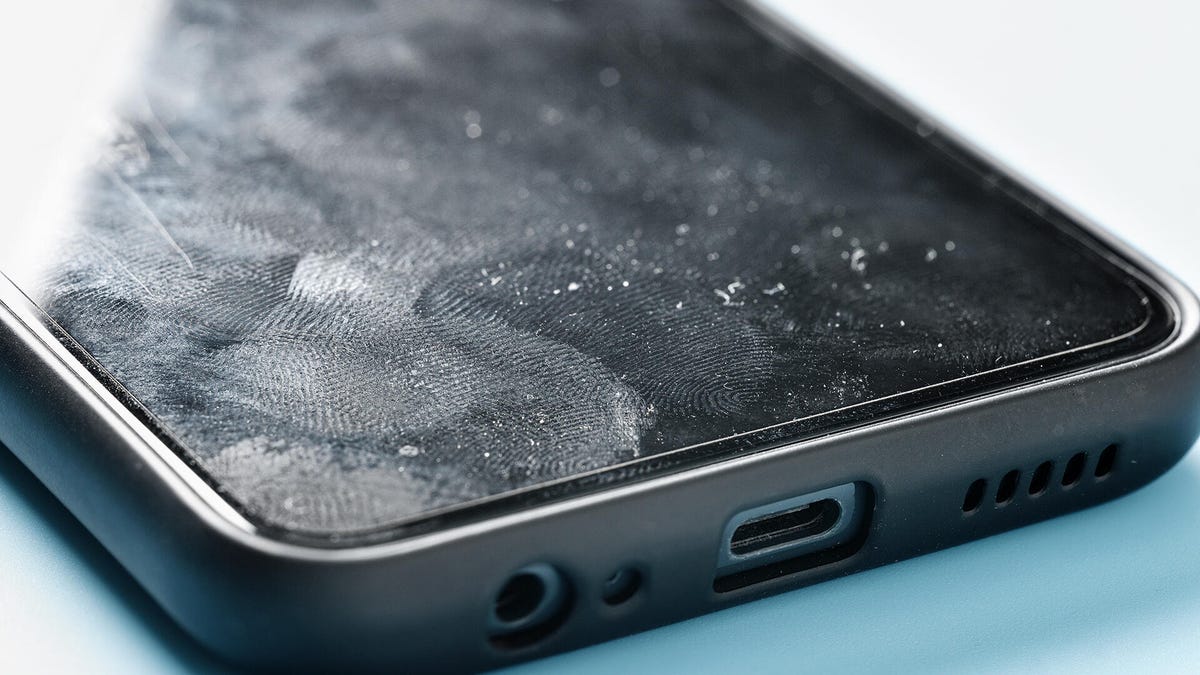
Does your phone screen look like this? I bet the camera does too. Few things can improve the quality of your photos more than a clean camera lens.
Serhii Shleihel/GettyImages
I can't stress enough how important this is. Well, I guess I can stress it since I'm putting it first. I'm amazed how often I see washed out and smudged images that are the result of fingerprints or other schmutz on the camera lens. Just cleaning your lens will improve the quality of your images probably more than any other tip.
How often? I literally check my camera lens before every group of photos. Important ones, anyway. Phone comes out of my pocket, I check the camera lens.
Ideally, you'll use a microfiber cloth, the same sort that comes with glasses/sunglasses. If not, even a soft shirt will be fine. Nothing rough or coarse. Nikon sells a nice microfiber cloth that comes in its own tiny neoprene baggie. This keeps it clean and conveniently on hand.
If you have a real camera, always (always always always) use a lens cap. I get such anxiety when I see people pull a camera from a bag, or have it dangling around their neck, and there's no lens cap. Scratches are even worse than smudges since they permanently decrease the image quality possible with the lens. Lenses are the eyeballs of your camera. Treat them as such.
If you're worried about losing your lens cap, or hate juggling it while you're handling your camera, check out cheap lens cap straps. They're great.
2. Tap the screen
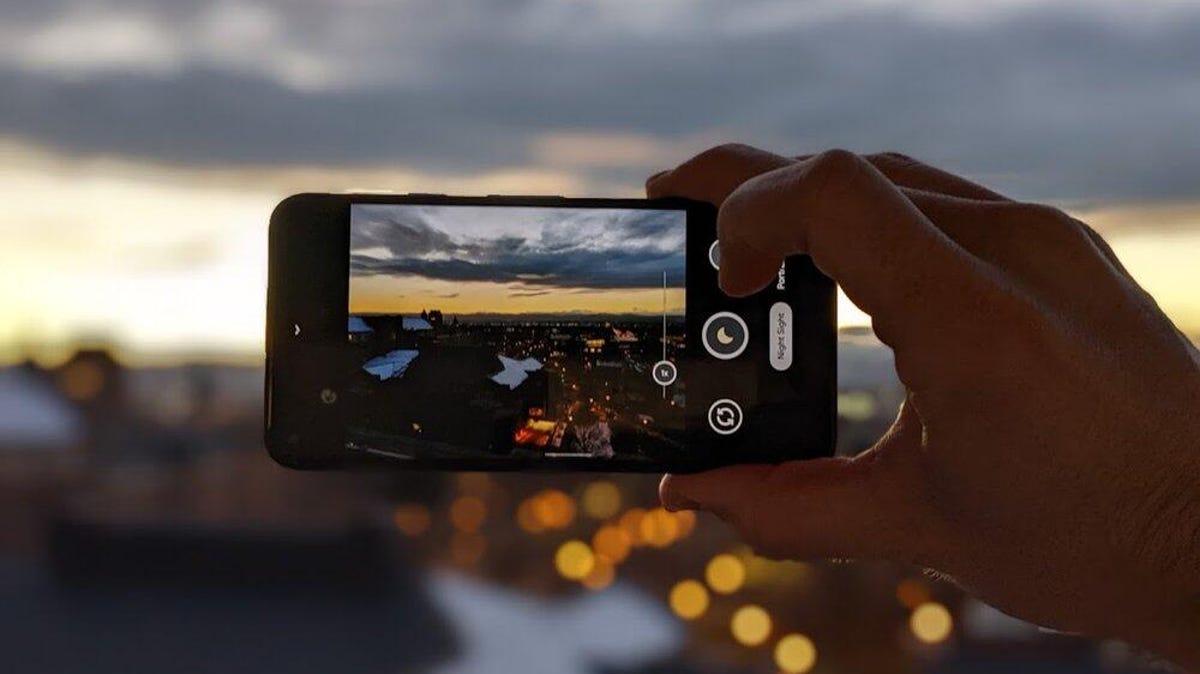
The camera app on a Google Pixel
Google
This always seemed obvious to me, but I've regularly caused "ah-ha!" moments giving this advice. When lining up your shot, if it doesn't look right, tap the screen. Most phones are pretty good at figuring out what you're trying to photograph, but not always. Tapping on your subject, a person, animal, thing, whatever, and changes the focus and exposure.
Here's an example. Say you want to take a photo of your partner on the beach at sunset. Three beautiful things in one photo: partner, setting sun, ocean. The beach too I suppose unless you don't like sand. This is called a backlit photo, and it's extremely hard to do. Most often, your partner will be underexposed (see the terminology section below), as in they'll look dark/shadowed.
With most phone and camera apps, you can tell the camera where to expose the image. In this case, on your partner. The sun will then be overexposed (blown out), but you'll still get the idea it's a sunset and you'll be able to see your partner, which is generally the point, right? If your phone is able to take HDR photos, this image will look better than if it can't.
There is some editing you can do to make a photo like this look better, but that can only go so far. We'll get to editing a little later.
3. Don't use the flash
If you're this close to your subject, sure, try the flash. Most phones and cameras have decent low-light capabilities, so the image might look better with the flash turned off. It's worth checking.
Jenner Images/Getty Images
There's no such thing as a good camera flash on a phone. They're all terrible. Even the big add-on flashes for full-size cameras only work in certain situations. Believe it or not, in most cases you'll get a better photo turning the flash off completely. Not 100% of the time, however, so it's worth trying both options.
This is especially true if you're using a full-size camera with built-in flash. In every scenic place I've ever been there's at least one person trying to take a landscape photo and their flash fires. Flashes, even the best, only work within a few feet of the subject. Not only will they do nothing for landscapes, they'll wear down your battery faster at best, and mess with the exposure at worst.
You can turn off the flash in your camera app's settings. More on that below.
There is such a thing as a Slow Sync Flash photography that can be great when trying to photograph people in front of a twilight or night landscape. I'd classify this as a bit more advanced, but with a bit of practice the results can be great!
4. Get a selfie stick
Grandma's gonna find that reindeer and enact revenge.
Geber86/Getty Images
Selfie sticks are good. I have apishly long arms and I still have one, though I typically use it for my 360 camera. My 80-year-old dad has one. They're great. People should take more photos of themselves, of their family and friends, everything. I honestly don't get the hate. Photos are great! Preserve whatever memories you can. Future you will thank you.
To put it more pragmatically, a selfie stick will let you get a wider field of view of yourself, the people you're with and where you are. It just makes for a better photo.
When you're using them, certainly be wary of your immediate surroundings and the people near you. Some locations, especially crowded or dangerous ones, tend to restrict selfie stick usage. Keep an eye out for signage.
If you're not sure how much you'll use it, there's this $8 option on Amazon that extends to 28.7 inches, has a Bluetooth remote built in, and has a base that extends out into a tripod. It collapses down quite small too. For something a bit more elaborate and sturdy for an action camera, GoPro's own 3-way 2.0 configures to a wide variety of positions and angles. It's made for their cameras, of course, but many action cameras use the GoPro-style mount.
5. Get a better angle
This is Smeagol and he is a Very Good Boy.
Geoffrey Morrison/CNET
Most people just bring the phone or camera up to eye level and take the photo. Sometimes that's fine, but you can often get far better results with a different angle. Try holding the camera above your head and aim down. Photographing people from below tends to be rather unflattering, but slightly above often looks great. If you're taking a picture of a kid or animal, get down to their level. A dog's-eye-view of a dog is almost always a more interesting photo than a human's-eye-view of a dog.
This is an aspect where a selfie stick helps. Extend it out and you'll be able to easily frame that epic photo of you and the fam at the Grand Canyon where you can see you, the fam, and the Grand Canyon instead of you, parts of the fam, and a sliver of the Grand Canyon.
6. Learn your app's settings and modes
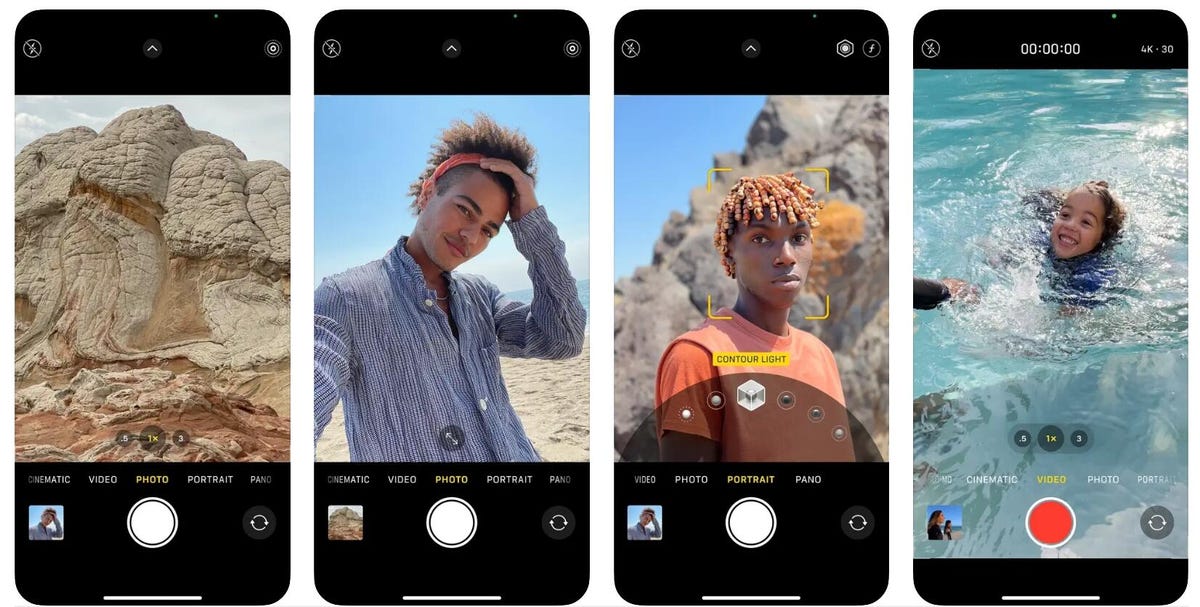
Changing the default settings on your phone's camera app can have big results.
Apple
Nearly every phone's camera app is capable of a variety of different photo styles. I'm always surprised to see how many people have no idea. Portrait mode, landscape mode and night mode all let you take vastly more interesting photos than the basic mode, all with just a few taps on the screen. Check them out, see what they do.
As far as settings go, generally the stock ones should be fine. It's worth checking to make sure it's taking the highest-resolution it can and that the flash is turned off (see No. 3). Some apps let you shoot RAW, more info on that in the terms section below.
I'd also recommend enabling manual controls, if available. They'll just take a few minutes to learn and they should help you get the photo you want when, like described in No. 2, the camera itself is struggling to do so.
Fun fact: Many camera apps have the option to use one of the phone's buttons as the shutter. If it's too hard for you to tap the screen while holding the phone, perhaps using the volume button instead will be easier. There are also timer functions that give you a countdown of a few seconds to get your pose and people ready.
Read more: How to Use the iPhone's ProRaw Mode to Make Your Photos Look Better Than Before
7. Editing
Note the different editing possibilities cycling through on the right.
Google
Nearly every great digital photo you've ever seen has gone through some amount of editing. Colloquially this is called "Photoshopping" but you don't need to pay Adobe for a subscription to that specific program. In fact, there are a lot of free options. Your phone might have some built in to its gallery already. Instagram has some great adjustments too. Beyond those, check out CNET's best free and paid photo editing apps for iPhone and Android.
The easiest way to learn is to just pick a photo and see what all the options do. Visually, it will be pretty obvious what things like contrast, brightness, and so on actually do. Most of them do the same thing on your TV, if you're interested.
Slight tweaks to contrast, brightness, and color will do wonders for any image. You can "slap a filter on it," sure, but starting with a better base image will usually make it look better after you apply a filter too.
Bonus! Cloud backup
Ymgerman
While not a camera tip per se, I very strongly recommend getting some sort of cloud backup for your photos. Integrated with your phone this means that whenever you're on Wi-Fi all your photos will get backed up to the cloud. With a real camera you can download them to the camera's phone app, and usually they'll get sent to the cloud from there. Sometimes, like with GoPro, there's an extra step required to save them to your phone's gallery.
With a cloud backup if you lose your phone or camera, you won't lose your photos. This saved me in a big way when I got robbed on an overnight train in Italy, and another time when a hard drive crashed on me.
Also, never forget, there are only two types of hard drives: Those that have failed, and those that will fail.
Check out our six ways to keep your photos safe in case of an emergency and best cloud storage services for 2022.
When to upgrade
As you get to know your phone's camera, you'll start to find its limitations. A limited zoom is going to be the most obvious, followed by noise in the image, a lack of settings, and so on. Some of you will start wanting more. It's a logical progression, one I bounded through myself, from inexpensive options to more and more expensive options. It's a pricey hobby, to be sure. Buying used can help.
I recommend checking out my Best Camera for Summer Travel article as a next step. It's aimed towards vacation/travel options, but should give you an idea what's out there and what the upgrade steps look like.
Terms and words and stuff
You'll find these terms when reading about actual cameras, as well as about phone cameras and within apps.
Wide angle: A type of lens that typically captures more than what you'd see with your eyes in one glance. The whole forest instead of a single tree, so to speak.
A wide angle photo, taken with my phone, of the Root Glacier in Wrangell-St. Elias National Park. Note the tiny people in the lower left.
Geoffrey Morrison/CNET
Telephoto: The tree, not the forest. Telephoto lenses let you capture images where you seem right up close to a subject but were actually far away.
Standing in the same place as the above photo, but with a 135mm telephoto lens on a Canon R6. These are the same hikers, a few minutes earlier, as they made their way across the glacier. Note how much closer they seem.
Geoffrey Morrison/CNET
SLR/DSLR: Single Lens Reflex/Digital Single Lens Reflex. Historically the "big, real camera." Usually a shorthand for a camera where you can change the lenses. Gradually being replaced, even among expensive cameras, with mirrorless versions.
Mirrorless: Lacking the moving mirror found in all SLR/DSLR cameras. What this means for you is the cameras are slightly smaller and lighter. Offered in a wide variety of prices. At the top end they're replacing professional DSLRs.
35mm equivalent: Refers to 35 millimeter film, the old standard, as a way to describe how wide, or telephoto, a lens is. For example, a 35mm-equivalent 12mm lens is wide, a 100mm lens is telephoto. Used as a relative reference since the actual focal length will vary depending on the size of the image sensor.
Optical zoom: This is the only real zoom. Uses glass or plastic lenses to make a subject appear closer.
Digital zoom: Best to think of this as "fake" zoom. It merely crops the image, and then upconverts it. Doesn't make the subject more detailed, just larger. OK if there's no other option, but the image quality is vastly inferior to optical zoom.
Underexposed: A subject or image that's darker than desired.
Overexposed: A subject or image that's brighter than desired.
RAW: An image format that's just very lightly processed data from the image sensor. At the professional level, RAW files are used almost exclusively as there is more range available to edit. However, you need to be knowledgeable with photo editing and have an app/software that can edit your camera/phone's RAW files. Not for beginners.
As well as covering TV and other display tech, Geoff does photo tours of cool museums and locations around the world, including nuclear submarines, massive aircraft carriers, medieval castles, epic 10,000-mile road trips, and more. Check out Tech Treks for all his tours and adventures.
He wrote a bestselling sci-fi novel about city-size submarines, along with a sequel. You can follow his adventures on Instagram and his YouTube channel.
Save money on netflix hulu hbo max and discovery save money on netflix hulu hbo max and youtube save money on netflix hulu disney save money on netflix hulu youtube save money on netflix hulu hbo save money on netflix hulu july 2022 how to save money on netflix how to save money on groceries ways to save money on a tight budget how to save money on hotels easy ways to save money how to save money fast
Save Money on Netflix, Hulu, HBO Max and More With This Clever Trick
Save Money on Netflix, Hulu, HBO Max and More With This Clever Trick
House of the Dragon, She-Hulk, and the upcoming season of Cobra Kai will keep our TV screens occupied. There are lots of great shows and movies across dozens of streaming services, but even subscribing to five of them could cost you more than $50 a month. (Just look at the latest pricing news for Disney Plus.) We're going to show you a trick that can help save you money.
Think about this: You subscribe to one or more services like Netflix, Hulu, Disney Plus or HBO Max, stream until your favorite series ends its season run, then look for the next thing to watch. But is it worth keeping multiple subscriptions active if you're not actively watching anything on them? I don't think so.
Here's a breakdown on our money-saving strategy and some tips on how to become a master at it.
Read more:Best Live TV Streaming Service for Cord Cutting in 2022
Rotate your streaming services
For cord-cutters, leaving pricey cable packages behind in favor of streaming is a win for the wallet. Because we're able to sign up for monthly plans, it's easy to jump into a streaming service and jump out when prices increase or content dries up. According to Deloitte's 2022 Media Trends report, the biggest reasons people cancel their streaming subscriptions are because of pricing and lack of fresh content. Media companies call this behavior "churn." We're calling this the rotation method.
The benefits? You save cash and avoid content droughts. Let's say a hot title like House of the Dragon or The Real Housewives is set to premiere on a service. Note the total episode count and wait until they're all available at once on a platform. You cancel HBO Max, Disney Plus or other service and then, once the episodes are available, resubscribe to catch up on your faves. Alternately, you can start streaming a show midseason to cut costs. My monthly guide on which streaming services to cancel can help you keep up.
The downside? You won't have immediate access to every show you want to watch and will have to wait until the full season airs. And since many streaming services release new episodes weekly, rather than all at once, you might not be caught up at the same time as your friends. If you're someone who prefers to watch episodes immediately when they drop, you may decide it's worth it to have multiple subscriptions at a time. If you have patience, however, you can save some money.
Read more: Best Streaming Device for 2022: Our Picks from Roku, Google, Fire TV and Apple
The strategy can also work if you have a live TV streaming service to keep up with a particular sport. Once the season wraps up, cancel the service and save big, or move to a cheaper platform with fewer channels like Sling TV.
Would you want to pay for four months of Disney Plus to watch Andor when you can catch all 12 episodes in November for the price of one month?
Lucasfilm
Tip No. 1: Cancel your streaming subscription before getting charged
Set calendar reminders for your billing cycle and upcoming TV show or movie release dates. Give yourself enough warning to begin or end a subscription. Apps such as JustWatch, TV Time and Hobi help you track when and where TV shows and movies appear on a streaming service.
Tip No. 2: Snag a streaming service deal
Look for discounts on streaming services. For example, Starz is offering a special rate of $5 per month for three months, which cuts its regular monthly rate of $9 nearly in half. You can also take advantage of the Disney Bundle, which provides access to Disney Plus, Hulu and ESPN Plus in one package for a reduced price. And eligible Hulu subscribers can add on Disney Plus for $3. Lastly, be sure to check with your mobile carrier to see which ones offer free streaming subscriptions.
Read more: Best Streaming Service Deals From Verizon, AT&T and T-Mobile
Tip No. 3: Pick one or two default streamers
Subscribe to one or two must-have services for the year, and select only one or two more options to fit your monthly budget. Rotate the bonus service(s) according to what you want to watch, ensuring you don't miss your favorite shows while sticking to your monthly spending cap.
Tip No. 4: Stick to monthly billing
Avoid annual subscriptions and pay attention to your auto-renewal payment dates. Your billing cycle can help determine when it's the best time to quit a service, even if you've only signed up for a free trial.
Tip No. 5: Don't cancel your streaming service, pause it
Hulu allows you to pause your subscription for up to 12 weeks, and Sling has a similar option with stipulations. Check with your streaming provider to see if you can take a temporary break without canceling.
Give it a shot, and if you don't like it you can always resubscribe. For more excellent tips on streaming TV, check out this guide to Netflix's hidden tricks and our recommendations for the best internet services.
Walmart Black Friday deals: Save big on AirPods Pro, TVs, smart home tech, fitness trackers and more
Walmart Black Friday deals: Save big on AirPods Pro, TVs, smart home tech, fitness trackers and more
This story is part of Gift Guide, our year-round collection of the best gift ideas.
We've been waiting for a while for Walmart's Black Friday deals to officially kick off, and the time is now here. Walmart officially began its Black Friday deals on Monday, Nov. 22 and will be running hundreds of Black Friday sales through the end of the week. The big box retailer kicked things off with a restock on both the PlayStation 5 and Xbox Series X, but as you'd imagine they sold out rather quickly. As it stands now, it's unclear whether or not we will see another restock ahead of Black Friday.
In addition to the restocks, we've seen some incredible Walmart Black Friday deals on Apple's AirPods and AirPods Pro, as well as some cheap 4K TVs, discounted robot vacuums and so much more. Our team is looking for Walmart Black Friday deals and updating this story often as we come across new ones.
You could spend your time looking through the ad yourself, or you could scroll down for an overview of all the best deals. There's a chance that we do see other retailers like Amazon, Target and maybe Best Buy matching these offers.
Walmart Black Friday deals at a glance
Here are all of our favorite Walmart Black Friday deals that you can take advantage of right now.
Today's best Walmart Black Friday deals
Walmart
If you don't already have an air fryer, Black Friday is a great time to pick one up. This Chefman 8-quart air fryer has a large capacity, multiple cooking presets and more. It's easy to clean and cooks great food, so what are you waiting for?
Instant Pot
This versatile multicooker features seven different cooking functions: pressure cook, rice cook, slow cook, yogurt, steam, sauté and keep warm. It also allows up to 13 customizable programs for quick, one-touch meals, so that you don't have to think about it. The fact that the lid is also dishwasher-safe makes cleanup just as easy.
iRobot
The Roomba i1 Plus empties itself into another container, meaning you don't have to think about it as often. Once you set it up the programming will do the rest, and it can even clean while you're away. The sensors can distinguish between carpet and hardwood, and can even detect the dirtiest part of your home, so it knows where to concentrate its efforts.
Beats
Featuring the Apple H1 chip (which offers fast pairing, Hey Siri support and more), these Beats headphones offer active noise canceling and last up to 22 hours between charges. They are also the first Beats to have an auto on/off feature connected to folding and unfolding the headphones, which makes using and storing them quick and painless, with no unforeseen drain on your battery.
Chris Monroe/CNET
Google's 2nd-gen Nest Hub smart display offers a 7-inch display that you can watch videos on, read recipes, host video chats and so much more. You can ask Google Assistant to help with math problems and conversions, to tell you the weather each day and even to help with controlling your smart home gear. At this price, you may want to just grab two of them since you're going to want them around the house.
Gateway
This 15" laptop is ultrathin and portable. It runs on Windows 10, which is being replaced by Windows 11, but it includes a free upgrade when available and a Microsoft 365 subscription is included for a year.
Walmart
The Instax Mini 7 Plus bundle is available in green, light blue, pink and purple, with the bundled items matching the color of the camera you pick. It comes with a few frames and photo holders for a little less than you can buy just the camera for right now.
Walmart
This cordless vacuum has all the standard capabilities you'd look for in a powerful machine while having the flexibility to transform into a portable machine for use on the go. Now, you can finally get those pesky spots in your car clean without much fuss.
Amazon
It's a robot vacuum cleaner that can suck up any debris in its path, which is a good thing because no one wants a vacuum that leaves crumbs behind. This vacuum can fit right in the tightest spots of your home, and clean both hardwood floors and carpet while you kick back and relax.
Walmart
If you're in the market for a new hard drive and you want one with a lot of storage, look no further than this hard drive from Toshiba. It features a 1TB storage capacity and stores all of your most important data in one location. You just need to plug it in and you're good to go.
More great Walmart Black Friday deals
In addition to all of the deals above, we've curated a list of more deals that are worth checking out as well.
Philips hue smart plug philips hue smart lighting philips hue smart lights home depot philips hue tap discontinued philips hue tap philips hue tap philips hue tap dial philips hue tape light philips hue play philips hue motion sensor philips hue pc
Philips Hue Tap: The best smart-home gadget you're not using
Philips Hue Tap: The best smart-home gadget you're not using
Today's smart home is dominated by ever-evolving voice controls, privacy anxieties, a confusing mish-mash of wireless protocols and constant jockeying between the platforms competing to rule it all.
Man. Sometimes, it's just nice to press a button.
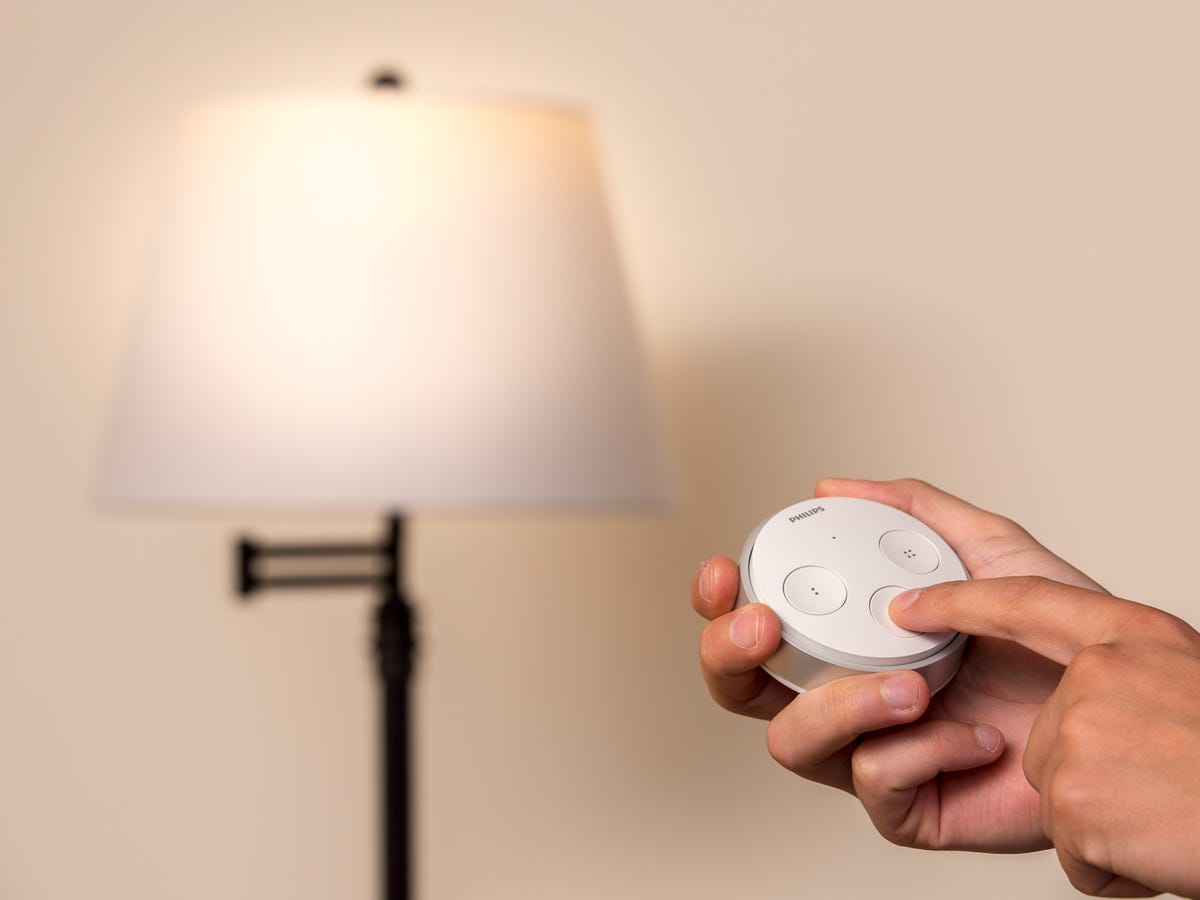
Better yet, how about four buttons? The four I'm thinking of belong to the Philips Hue Tap, a wireless remote for Philips Hue smart lights that predates the Amazon Echo and the rise of smart-home voice controls that came with it. First out in 2014, it's ancient in smart-home years, but it's always been a favorite of mine -- and it's only gotten better since it first came out. In fact, at $50, I'd go so far as to call it one of the most underrated smart home gadgets you can currently buy. Let me explain.
The Hue Tap needs no batteries -- it's self-powering, and generates its own kinetic energy each time you press a button.
Tyler Lizenby/CNET
It comes with infinite battery life
The first thing you need to know about the Hue Tap is that you'll never need to worry about changing the battery. In fact, it doesn't have any batteries at all. It's a kinetic, self-powering device that generates its own energy from your button-presses. Seriously.
Case in point: the CNET Smart Apartment, where we control the bedroom lights using the very same Hue Tap that I first reviewed four years ago. It's never failed us, and it always toggles the lights without any lag at all.
One reason for the speedy performance: The Hue Tap transmits your button-based input directly to the Hue Bridge using a low-power Zigbee signal. From there, the Bridge relays the lighting change to your Hue bulbs with another Zigbee transmission. The whole process is completely separate from your Wi-Fi network, which makes for terrific performance on a platform as stable as Hue's.
And again, the thing is literally finger-powered. If only my TV remote worked the same way.
It's versatile
The puckish Hue Tap works well as a handheld remote, but you can also stick the base plate that comes with it to the wall, then dock the thing as a makeshift light switch when you aren't carrying it around. Doing so makes for a really good, kid-friendly smart lighting hack: The face of the Tap, which is a button itself, can toggle the lights on and off, while the three smaller buttons can each trigger a favorite preset.
That's much better than using the normal switch, which will leave your smart bulbs unpowered and unreachable whenever it's switched off. Plus, you can stick the Tap a little lower on the wall where your kid can reach it. If your kid hits a growth spurt, the sticky tabs on the back are fairly easy to remove.
In the Smart Apartment bedroom, we keep a reading lamp by each side of the bed. The left and right buttons on the Hue Tap turn the respective lamp on, while the middle button turns them both on. The large face of the button turns the lights in the living room and kitchen off, which would come in handy if you curled into bed only to realize you'd left a few lights around the house on.
Having a button handy in the bedroom is also a nice alternative to voice controls. If you're up late reading a book, and sharing a bed, a voice command might wake up your sleeping partner. And while pulling out your phone and using the Hue app to turn the lights off is always an option, I will always prefer a simple, dedicated device like the Tap that lets me leave my phone plugged in on the nightstand. The less I have to look at a screen late at night, the better.
It works with Apple HomeKit
The Hue Tap also received a nice upgrade last year when Philips started letting users pair the thing with Apple HomeKit smart home setups. Once you do, you can start using it to control other smart home gadgets that work with HomeKit: lights, locks, shades, you name it.
Things get really interesting when you start using the Tap to trigger HomeKit scenes that affect the status of multiple devices at once. For instance, you could create a "Goodnight" scene in Apple's Home app that turns off all of your smart lights, sets the smart thermostat to your preferred sleeping temperature and locks the front door's smart lock -- then trigger it all with a single tap.
Just remember that you'll still need a Hue Bridge plugged into your router to receive the Tap's Zigbee signal. You can't, for instance, pair it directly with an Apple TV or a HomePod for direct HomeKit control.
A setup like the one in the CNET Smart apartment bedroom with two smart lights, a Hue Tap remote, and a Hue Bridge to control everything would cost you $120 at full price, and would make a great foundation to expand upon, bulb by bulb. Philips Hue products are also frequently on sale.
Chris Monroe/CNET
It doesn't cost a fortune
The Hue Tap cost $60 when it first came out, but Philips has since lowered the price to $50. That's still a little expensive, but it's not unreasonable for a device you could conceivably use every day. And it isn't hard to catch Philips Hue gadgets on sale.
You'll find some very handy tricks on the Hue Labs website, including one that lets you use the Tap as a dimmer.
Screenshot by Ry Crist/CNET
As for the lights themselves, a color-changing Hue starter kit won't come cheap at $200. I say the smarter play is to go is with the non-color-changing Hue White starter kit that includes two white-light bulbs and the essential Hue Bridge for $70 (again, keep your eyes peeled for sales). Pair that starter kit with the Tap for a total of $120, and you're looking at a very solid and functional start to your smart lighting setup, and one that you can expand upon whenever Hue's running a discount on extra bulbs and accessories.
The Hue team tells me that it will continue to offer the Hue Tap for the foreseeable future, especially since support for Apple HomeKit was introduced less than a year ago.
"Customer feedback on the Tap is positive," a Hue spokesperson tells me, though they also add that the more standard-shaped Hue Wireless Dimming Switch tends to be selected more often because of the familiar-looking design.
I like that dimmer switch, but folks have it backward (and I'd point out that an easy-to-use Hue Labs hack lets you use the Hue Tap as a dimmer, too). With great customizability, terrific ease of use and no need for batteries ever, the Hue Tap is the superior smart lighting controller -- and one of the most underrated little smart home gadgets available today.
Disclosure: CNET earns commissions from the purchase links featured on this page.
This story is part of The Year Ahead, CNET's look at how the world will continue to evolve starting in 2022 and beyond.
The years 2020 and 2021 served as a reminder of just how central computers are to work, school, home and just about everything we do. It started around March 2020, when many people took their work laptops home, and then didn't return to the office for over 18 months, if at all.
During that time, we changed how we attended meetings, collaborated on projects and learned new things. But, for the most part, our work-from-home and learn-from-home tools were the same as the ones we had before the COVID-19 pandemic.
Unfortunately, that work laptop just wasn't designed for all-day video meetings, or for sitting in a virtual classroom. Case in point: Most laptops during this time still had lousy webcams and merely adequate microphones. You could always tell when someone had a hard-to-find full-HD standalone webcam (or better) with a good eye line and clear image. Many people were stuck with something like a MacBook Air, with a tilted up-the-nose shot and soft and blurry image.
It's not that we didn't know that turning every home office into a primary office would mean more people would want better cameras, mics, displays and more. But reacting to that need -- by designing a new product or new features, then getting something manufactured and into stores -- is a multi-year process. That's why it's only as we step into 2022, at CES and beyond, that we're starting to see even simple features like full-HD webcams go mainstream.
The pandemic also made one-laptop-per-person even more of a rule than it already was. That's because every single household member, adults and children, needed their own full-time system. You might have your office laptop with you -- but it might be old and junky enough (or so corporate) that you'd want something else. You or your spouse might be a freelancer and need their own laptop. Meanwhile, every school-age child in the family suddenly needed a separate laptop for remote schooling -- no more sharing a system for the kids or having a centrally located family PC.
Here's how these trends, pushed into high gear by the pandemic, are going to be reflected in the new PCs and laptops of 2022 and beyond.
HP's ultralight Elite Dragonfly laptop.
HP
Easy fix: Betters webcams and mics
For years, the 13-inch MacBook Air was the single most universally useful laptop most people could buy. With one significant flaw – the mediocre 720p webcam. See enough of these and you could almost tell who in your Zoom meeting was on a MacBook, just as some experienced radio DJs can tell which microphone someone is using just by the sound.
To its credit, Apple started rolling out better cameras right away, starting with the 2020 version of the 27-inch iMac. I appreciated its 1080-pixel camera so much I ended up dragging it from one corner of my house to the other just to use the webcam and mic in meetings and TV appearances. The trend continued in the 24-inch iMac and the new 14-inch and 16-inch MacBook Pro laptops.
Now, and into 2022, you can expect many more full-HD cameras in laptops from Lenovo, Dell and others. It won't be in every model, as it's still an additional expense and frankly may require a larger camera unit, but it gets closer to becoming the universal standard every day. And whether you're working from home, in an office or both, that's a good thing.
The latest MacBook Pro laptops already have upgraded 1080p webcams.
Dan Ackerman/CNET
New recycled ideas
Everyone wants their product to be green, and sometimes it's even for non-publicity reasons. I've heard about laptops and accessories that used a certain amount of recycled plastic, or recycled paperboard in computer packaging, but 2022 means even more laptops will be built around recycling materials and reusing parts.
Dell impressed me recently with a new concept demo called Luna. The idea is that your laptop will have many more user-accessible parts, not so much so that you can upgrade them later on (although I'd still like to see that), but more so you can swap out old or defective parts and Dell can reclaim the unused ones without junking the whole laptop. It also makes it easier to trade in a used laptop so the hard drive, CPU, RAM and other components can be stripped out and slotted into new machines.
The Luna is just a concept project, not a real laptop line, but I'm hoping some aspects of it will make it into real products sooner than later.
What you can look forward to from computers in 2022 is more recycled material in laptop packaging and even power adapters, even if that's tougher to do with the laptop body itself.
The new Dell XPS 13 Plus also sported a few cutting edge upgrades, including a capacitive touch function key row and an all-glass front lip.
Dan Ackerman/CNET
New ways to work
Some upcoming innovations promise to ease a little of the awkwardness that remote work brings. A few of these have already been announced, like Dell's Flow concept, which automatically connects and disconnects a laptop from a secondary display based purely on proximity. I also liked Dell's Pari webcam prototype, which is wireless and able to stick itself anywhere on your screen to get the perfect eye line. Or you could just pick it up and aim it anywhere, from the whiteboard across the room to the brilliant idea you sketched out on a cocktail napkin.
These developments are still in the concept or prototype stage, so don't expect them any time soon. But I think we will see more innovative helper apps and features this year, like laptops that can alert you when someone is peeking over your shoulder or that can log you in with facial recognition, even when you're wearing a mask.
The final frontier may be the smart desk. What will it look like and what will it do? I don't think there's universal agreement on that yet, but I suspect it'll start with wireless charging and may move into secondary displays, ergonomic adjustments and more.
Wider chip choices
Two big forces are helping laptops and other computers move away from being so dominated by Intel chips. One is that wide adoption of Chromebooks, especially from students engaged in some level of remote learning, is opening the door to more ARM-based laptops, which were previously nonstarters in the Windows world.
Second, Apple's aggressive timeline for shifting the entire Mac lineup from Intel to its own M-series chips has shown that laptops that skip Intel or AMD chips don't have to skimp on performance. In fact, the latest M1 Pro and M1 Max MacBooks are miles faster than most of the Intel models they replace. Google is said to be prepping its own chip, specifically for Chromebooks, as well.
Still, Intel controls roughly 75% of the computer market, and this widening of the playing field may be affected by many factors, including ongoing chip supply shortages. And since so many people had to splurge for an emergency upgrade to a new laptop over the past 18 months, those people may be reluctant to upgrade again so soon.
Chris Evans Wants the iPhone's Home Button Back -- Here's Why That's Important
Chris Evans Wants the iPhone's Home Button Back -- Here's Why That's Important
Chris Evans, aka Captain America, aka Buzz Lightyear, is making as much Apple news lately as the rumored iPhone 14. Like all of us do from time to time, Evans upgraded his old iPhone to a new one. So what's all the hubbub about? Turns out, he's been using an iPhone 6S all this time. Back in June, in a post on Instagram he shared an RIP for his old iPhone 6S, a phone released in the Obama administration.
Clearly a celebrity of his stature could afford the latest and greatest when it comes to phones. The fact that Evans held onto his iPhone 6S for so long speaks volumes about his character and perspective. I daresay this makes him seem more down-to-Earth and cooler, too.
And if the story stopped there, great. But while promoting his new film The Gray Man on Netflix, Collider's Steve Weintraub asked him about his old phone and Evans replied, "I miss it." The Knives Out star admitted that he misses the home button and that his new iPhone 12 Pro feels too heavy. His co-star Ana de Armas, sitting next to Evans, chimed in sympathetically, and showed how her iPhone leaves a line on her pinky finger.
Evans opened up about his iPhone situation more passionately saying, "I want something to work until it doesn't work anymore." This is simultaneously profound and a spot-on criticism of our disposable global culture.
OK, so how did we get here? Last month, Chris Evans posted a photo to Instagram that showed him transferring data from his iPhone 6S to a new iPhone. He wrote, "RIP iPhone 6S. We had a good run. I'll miss your home button. I won't miss the nightly battle of trying to get you to charge. Or your grainy pictures. Or your sudden drops from 100% battery, to 15%, to completely dead all within minutes. It was a wild ride. Rest easy, pal. #tilthewheelsfalloff"
A fitting tribute to an old iPhone. But why did he hold onto his old iPhone for so long? The short answer, it seems, is for the home button. It's an actual button. In his Collider interview, Evans dismissed people saying he should get an iPhone SE, which is the only iPhone Apple currently sells with a home button. It's implied that Evans knows that the iPhone 6S had the last actual home button on an iPhone. When Apple released the iPhone 7 it replaced the physical button with a circular spot that used haptics to mimic a physical button's action and feedback. This same faux-home button is on the iPhone 8, 8 Plus, SE (2020) and SE (2022).
Though his iPhone 6S barely worked, it seems he held onto it for another reason: the principle of the whole thing. Why get a new phone when an old one worked perfectly fine? Granted, it seems Evans used the 6S as long as he could -- over six years, assuming he bought it the year it came out. And while Evans didn't mention it, the iPhone 6S is not getting the update to iOS 16, likely meaning it's time for other iPhone 6S owners to move on to a newer model if only to maintain protection from security vulnerabilities.
Every year phone-makers release new models. On one hand this yearly cycle lets companies upgrade their phones' hardware to be more competitive. But on the other hand, it's quite wasteful. Other tech products like headphones and cameras aren't on a yearly upgrade cycle and years can pass between models. Add in complicating factors like the removal of a home button entirely and things like a headphone jack and it's easy to understand Evans' frustration. He had a phone with a home button that's lightweight, then "upgraded" to a new iPhone that's heavier, and lacks a home button and headphone jack entirely. I'd be less than thrilled, too.
Apple, Google, Other Tech Giants Urge Texas to Drop Anti-Transgender Legislation
Apple, Google, Other Tech Giants Urge Texas to Drop Anti-Transgender Legislation
More than 60 companies, including tech giants Apple, Google, Microsoft, Meta and Salesforce, signed an open letter calling for Texas Gov. Greg Abbott and other lawmakers to abandon an order that equates gender-affirming medical care for transgender children to child abuse.
The letter, published in a full page ad in the Dallas Morning News on Friday, calls for an end to "efforts to write discrimination into law and policy." It was organized in partnership with LGBTQ+ civil rights group Human Rights Campaign.
"The recent attempt to criminalize a parent for helping their transgender child access medically necessary, age-appropriate healthcare in the state of Texas goes against the values of our companies," reads the open letter. "This policy creates fear for employees and their families, especially those with transgender children, who might now be faced with choosing to provide the best possible medical care for their children but risk having those children removed by child protective services for doing so."
See Also:In Texas, Big Tech's Liberal Leanings Take a Back Seat
In February, Abbott directed state agencies to investigate claims of children receiving gender-affirming medical care. The order also requires medical professionals and teachers to report children receiving care or face "criminal penalties."
The move drew swift backlash from civil rights groups and medical organizations. The American Medical Association supports "patient-led" gender-affirming care and has said attempts by states to prohibit care for minors patients are "inappropriate and harmful."
Apple CEO Tim Cook also spoke out about the issue in a tweet on Thursday. "As a proud member of the LGBTQ+ community, I am deeply concerned about laws being enacted across the country, particularly those focused on our vulnerable youth," Cook wrote. "I stand with them and the families, loved ones, and allies who support them."
Other companies that signed the letter include Box, Capital One, Cisco, Corning, Dropbox, Electronic Arts, Gearbox, IBM, Ikea, Johnson & Johnson, Patreon, PayPal, Pinterest, Shutterstock, SXSW, Unilever, VMWare, Yahoo and Yelp.